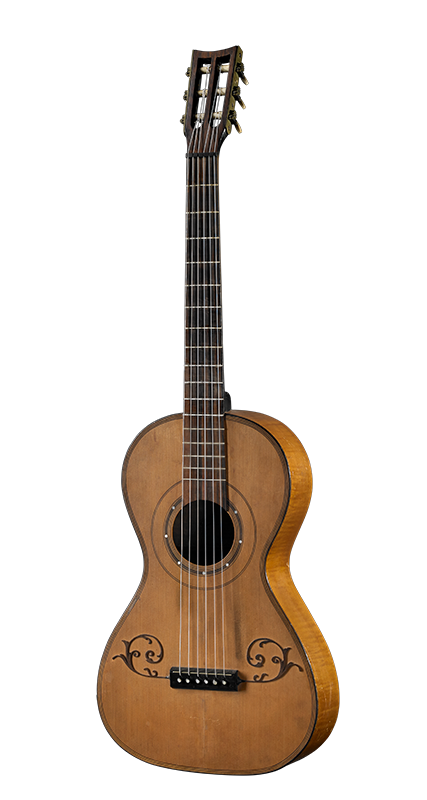
Thomas Preston was the son of the famous eighteenth-century London-based “guittar” maker John Preston (1727–1798). The English guittar (known as a cistre on the Continent) was a plucked-string instrument, similar in shape to a sixteenth-century cittern. Strung with wire, its six courses were tuned to an open-C chord and used extensively for accompanying the voice. The instrument was widely popular throughout Britain and Europe in the second half of the eighteenth century.
Specifications
Date
c. 1822
Location
London, England
Length of Guitar
925 mm
String Length
641 mm
Upper Bout Width
228 mm
Waist Width
163 mm
Lower Bout Width
298 mm
Side Depth at Waist
80 mm
Soundboard: Spruce | Back: Maple | Sides: Maple | Details: Hand-cut ebony appliqué mustache applied to the soundboard
The elder Preston made improvements to the guittar, including his patented watchkey tuning mechanism that replaced less effective wooden tuning pegs. His watchkey tuners were so popular they became known as “Preston tuners” and were marketed and sold separately to other English guittar makers. When John Preston died in 1798, his son Thomas took over the family business, selling instruments and publishing music.
At the turn of the nineteenth century, the six single-string guitar became increasingly popular throughout Britain and the Continent. The English referred to the newer six single-string design as the “Spanish” guitar to differentiate it from the older cittern-shaped English guittar.
By 1821, Preston had moved the business from the Strand to Soho Square where he increasingly focused on the publishing side of the business until his death in 1834. This may explain why there are only two extant six single-string guitars from his shop. Preston wasn’t a luthier but the two surviving guitars bearing his label were clearly made by the same maker. A signature, “T. Poole Maker/London,” can be found on the underside of the soundboard of both guitars.
The Thomas Preston guitar in the Austin-Marie Collection, with its primitive mechanical tuners and simple design, was likely built around 1822. (Preston quit advertising as a musical instrument dealer in 1824.) The soundboard is made of spruce and the back and sides of maple. The applied fingerboard has been fitted with ivory frets, meeting the body at the octave, or twelfth fret. The headstock is similarly shaped to that of the 1822 Panormo in this collection. The Baroque-style bridge mustaches and single-piece back suggest this guitar is the earlier-dated of the two extant Preston guitars.