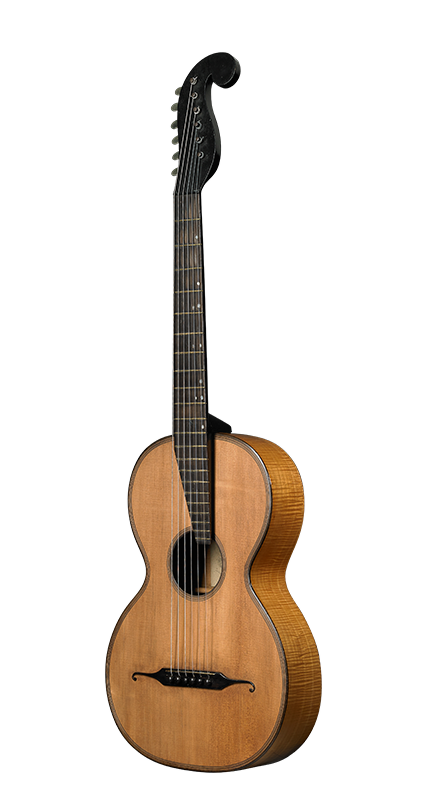
Johann Georg Stauffer had three sons: Franz, Johann Anton, and Alois. His second son Johann Anton (1805–1871), pursued a career as a pianist in his youth but began working for his father building guitars in 1826. He took over the family business in 1833, although Georg continued to make guitars well into the 1840s.
Specifications
Date
c. 1831
Location
Vienna, Austria
Length of Guitar
927 mm
String Length
606 mm
Upper Bout Width
235 mm
Waist Width
168 mm
Lower Bout Width
297 mm
Side Depth at Waist
72 mm
Soundboard: Spruce | Back: Maple | Sides: Maple | Details: Scroll-shaped headstock with encased inline tuners; adjustable neck
Johann Anton built instruments to his father’s design and like his father’s guitars, his were much sought after and highly prized. The c. 1831 Anton Stauffer in the Austin-Marie Collection has the same attributes and overall design elements found in his father’s guitars. (See the c. 1828 Johann Georg Stauffer in this collection.) The soundboard is made of spruce and the back and sides of maple. The bridge with its downward-pointing mustache is a typical Viennese design. The narrow neck is fitted with 22 frets and topped with a Viennese scroll-shaped headstock with enclosed inline tuners. The label identifies the guitar as a “Legnani” model—another example of a player-maker collaboration. Guitar virtuoso-composer Luigi Legnani (1790-1877) advocated for a broader dynamic range and easier access to the upper frets, resulting in deeply curved bouts, a narrow waist, and an adjustable raised fretboard.