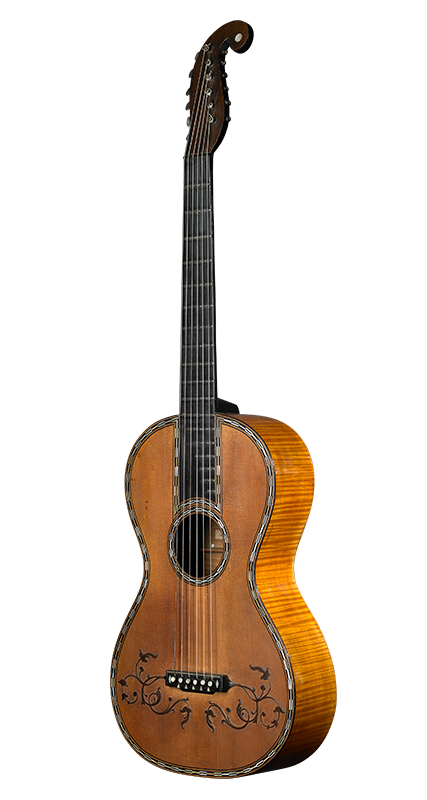
Joseph Mathias Neüner III (1762–1830) of Mittenwald was part of the Neüner dynasty, which traced its roots back to the seventeenth-century luthier, Mathias Neüner I.
Specifications
Date
c. 1820
Location
Mittenwald, Germany
Length of Guitar
960 mm
String Length
643 mm
Upper Bout Width
240 mm
Waist Width
177 mm
Lower Bout Width
295 mm
Side Depth at Waist
85 mm
Soundboard: Spruce | Back: Curly maple | Sides: Curly maple | Details: Ornate, hand-cut ebony appliqué applied to the soundboard
There is very little published information on the German guitar makers, especially from the region of Bavaria bordering Austria. German guitars in the first half of the nineteenth century were also rarely labelled, but the guitar attributed to Neüner in the Austin-Marie Collection has all the earmarks of his work.
The Viennese influence is immediately apparent. The scroll-shaped head is similar to those by Stauffer, except the neck is fixed, not adjustable, with the fingerboard flush to the soundboard. The in-line tuners are encased into the head, and opposite each tuning key is housed a bridge pin which can be removed for easy access to lubricate the mechanism.
The soundboard is made of supremely tight-grained Alpine spruce, most likely sourced from the local Karwendel Mountains. The bridge is terminated with a flowering ebony appliqué inspired by the Italians, who in turn strongly influenced the Viennese makers. The mother-of-pearl and ebony inlays, both marginal and in the rosette, are similar to those found in selected French guitars by Pons and Guiot. The one-piece back is made of curly maple, and uniquely—and seemingly idiosyncratic to this maker—the sides are made of a single long piece of maple bent into the shape of the entire body.
It is rare to see Austro-German guitars with an original case. This guitar, however, has a made-to-measure traveling case veneered in figured Cuban mahogany.