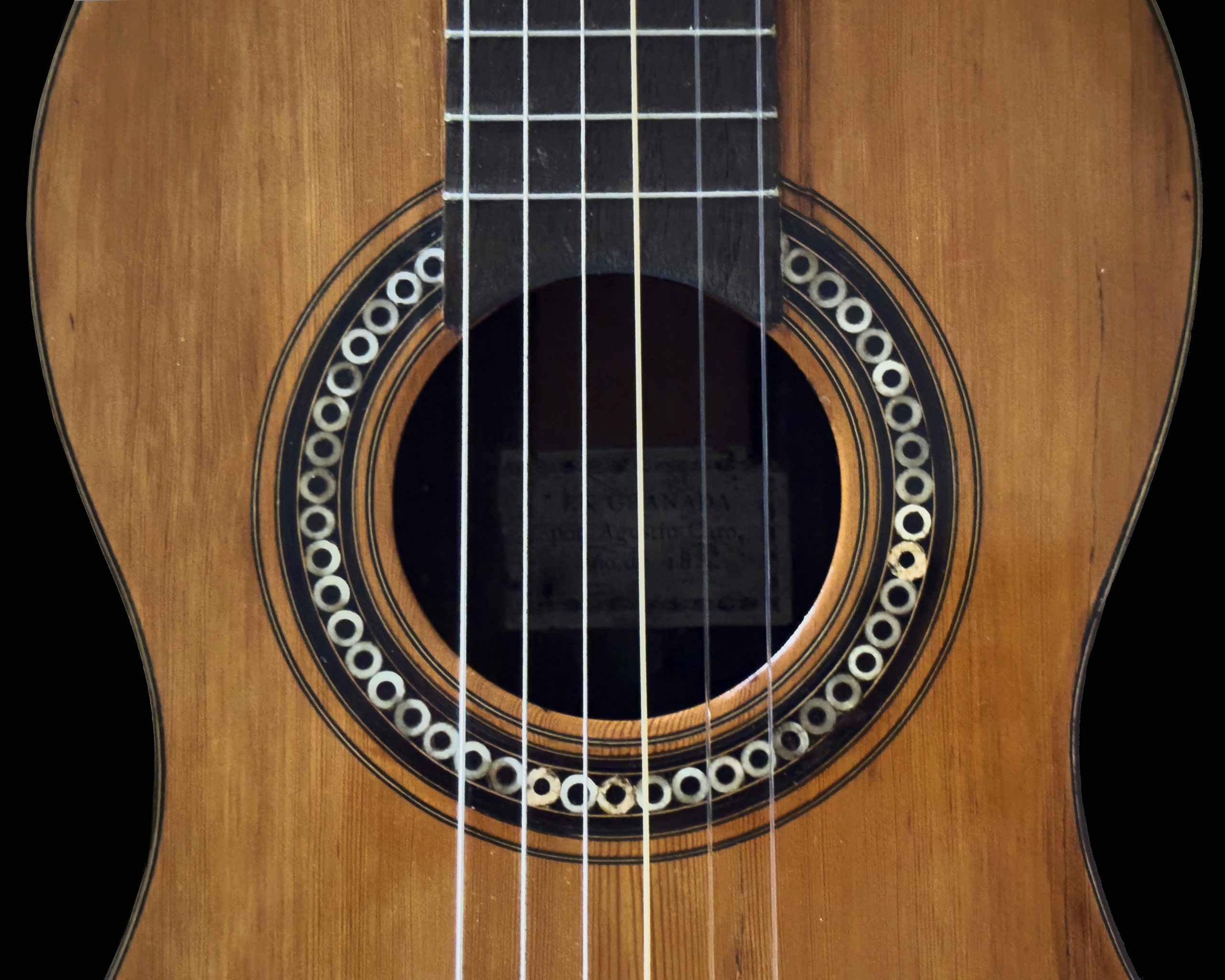
Surprisingly little is known about Agustín Caro of Granada except for what the six surviving guitars built between 1803 and 1829 can tell us about his work. The amount of missing historical evidence regarding his life and family, date of birth and death, his professional associations and training, the location(s) of his workshop(s), etc. is perplexing considering his groundbreaking contributions. It is because of his historical role in advancing guitar design, that one of Caro’s guitars has found its way into the Austin-Marie Collection.
Spanish luthiers built their guitars to accommodate courses (double strings) long after European builders had transitioned to single strings in the second half of the eighteenth century. (For an explanation as to why Spanish luthiery likely remained insular, see the 1803 Manuel Martínez in this collection: https://austinmarieguitars.com/guitar/manuel-martinez/.) Even at the onset of the mid-eighteenth-century European transition from courses to single strings, Spanish guitars were further differentiated by the number of courses used, fitted with six instead of five. (Five was the standard configuration on the Continent.) Slow to change, Spanish guitar makers continued to manufacture six-course guitars late into the first quarter of the nineteenth century. A Caro guitar from 1803, however, slowed the trend. Configured for six individual strings, it is the earliest known example of a single-string guitar by a Spanish luthier.
Marking a significant milestone in guitar design was Caro’s introduction of an applied fretboard extending to the soundhole. Hitherto in Spain and elsewhere, frets beyond the neck joint were embedded in the soundboard. A raised fretboard led to a number of positives. These included the ease of playing notes in the higher registers, and as a raised fingerboard required a change in the height of the bridge to create greater string clearance from the soundboard, this clearance better accommodated nail playing and arguably more forceful playing.
Caro has also been credited for being the first luthier to introduce an adjustable bridge saddle, however, Sinier de Ridder points out in their comprehensive work, The Spanish Guitar, 1750-1950, that the use of an adjustable bridge saddle appeared in France and Italy around the same time, making it inconclusive as to whom to credit for its introduction. (Note: the bridge of the Caro in this collection is not fitted with an adjustable saddle.)
The 1826 Agustin Caro guitar has back and sides made of Brazilian rosewood with a spruce soundboard. Its friction peg tuners are typical of Spanish guitars from the first half of the nineteenth century as the Spanish were slow to adopt mechanical tuners. The guitar is well made, and with its deep body combined with an understated elegance, it establishes an important link to the seminal work of Antonio de Torres.