Louis Schmidt and George Maul were two of the leading figures on a long list of business associates, craftsmen, and suppliers who worked with C. F. Martin during his formative years in America.
Schmidt likely apprenticed under Martin in Neukirchen (officially renamed Markneukirchen in 1858), Saxony. At the age of 19, his name appears on the manifest of the sailing ship Columbus, the same ship carrying Martin and his family when it arrived in New York Harbor in November of 1833. Schmidt worked for Martin for the next few years, living with the Martin family in the upstairs of their 196 Hudson Street business establishment on the Lower West Side of Manhattan. The Martin ledger shows that George Maul, a cabinet maker working in Lower Manhattan, did contract work for Martin in 1838.
Schmidt set out on his own in 1836 and in 1838 partnered with Maul to form Schmidt & Maul, a guitar manufacturer that unsurprisingly built guitars similar in design to Martin’s. Schmidt worked until his retirement in 1858 while Maul continued to build guitars under his own name until 1869.
Beyond dating their guitars, much of Schmidt and Maul’s work is indistinguishable from Martin’s, including the mix of Germanic and Spanish influences, the bracing of the soundboard, the similar purfling and rosette motif, the design of the maker’s stamp, and the choice of Jerome tuners.
The 1849 Schmidt & Maul guitar in this collection may have been a custom order. The most striking feature is its scroll-shaped headstock. By the late 1840s, inline Viennese tuners imported from Austria were a rare and expensive accessory as the influence of the Spanish makers of Cádiz saw American luthiers most often building guitars with square-top heads.
Despite the 1849 Schmidt & Maul’s Viennese tuners, the guitar has all the hallmarks of the Spanish School with its general shape and depth, tie bridge, three-fan braces securing the spruce soundboard, Spanish heel and neck block, and back and sides of rosewood. The pyramid bridge, understated rosette ornamentation, and radiused neck are primarily American attributes.
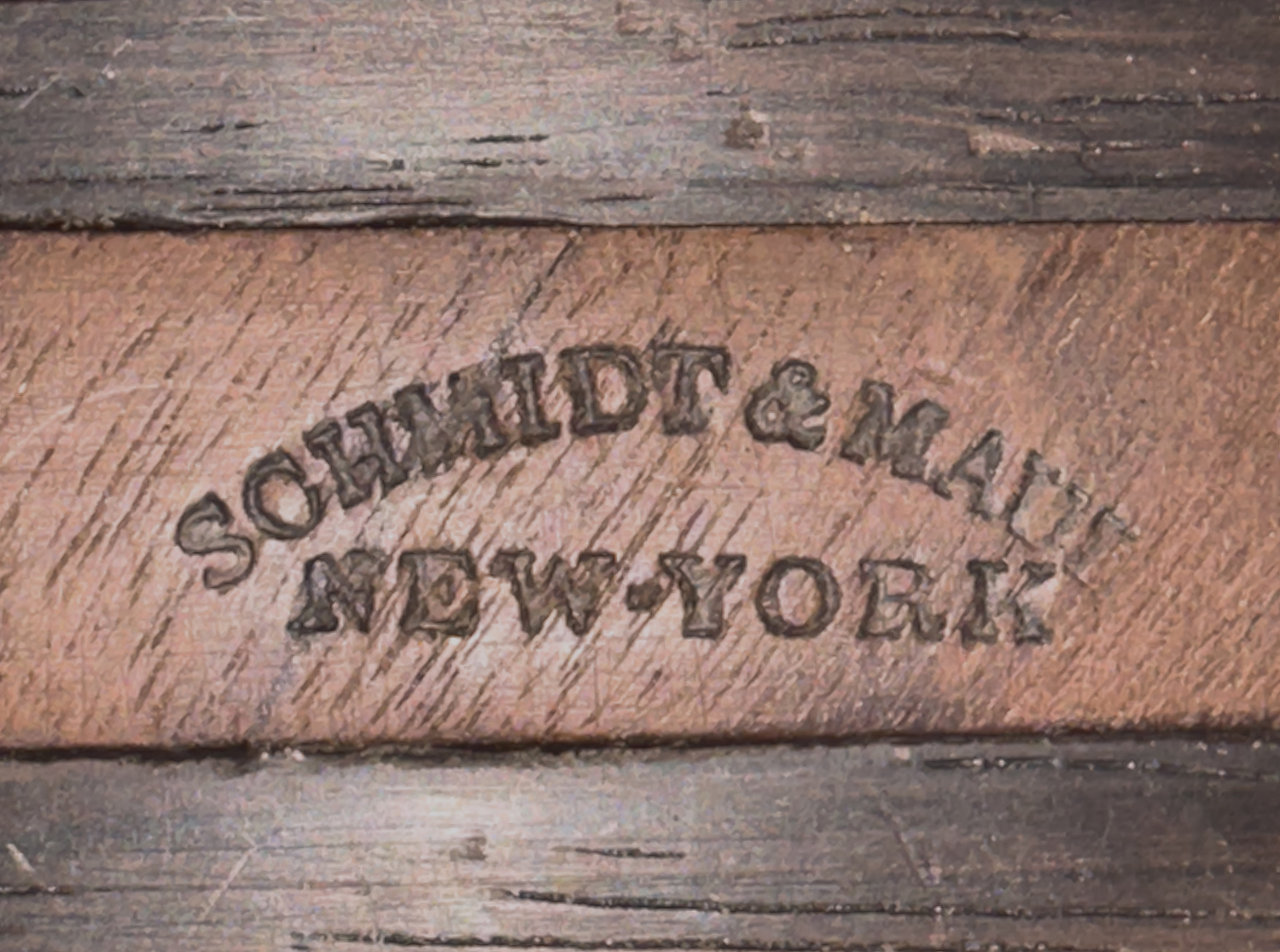
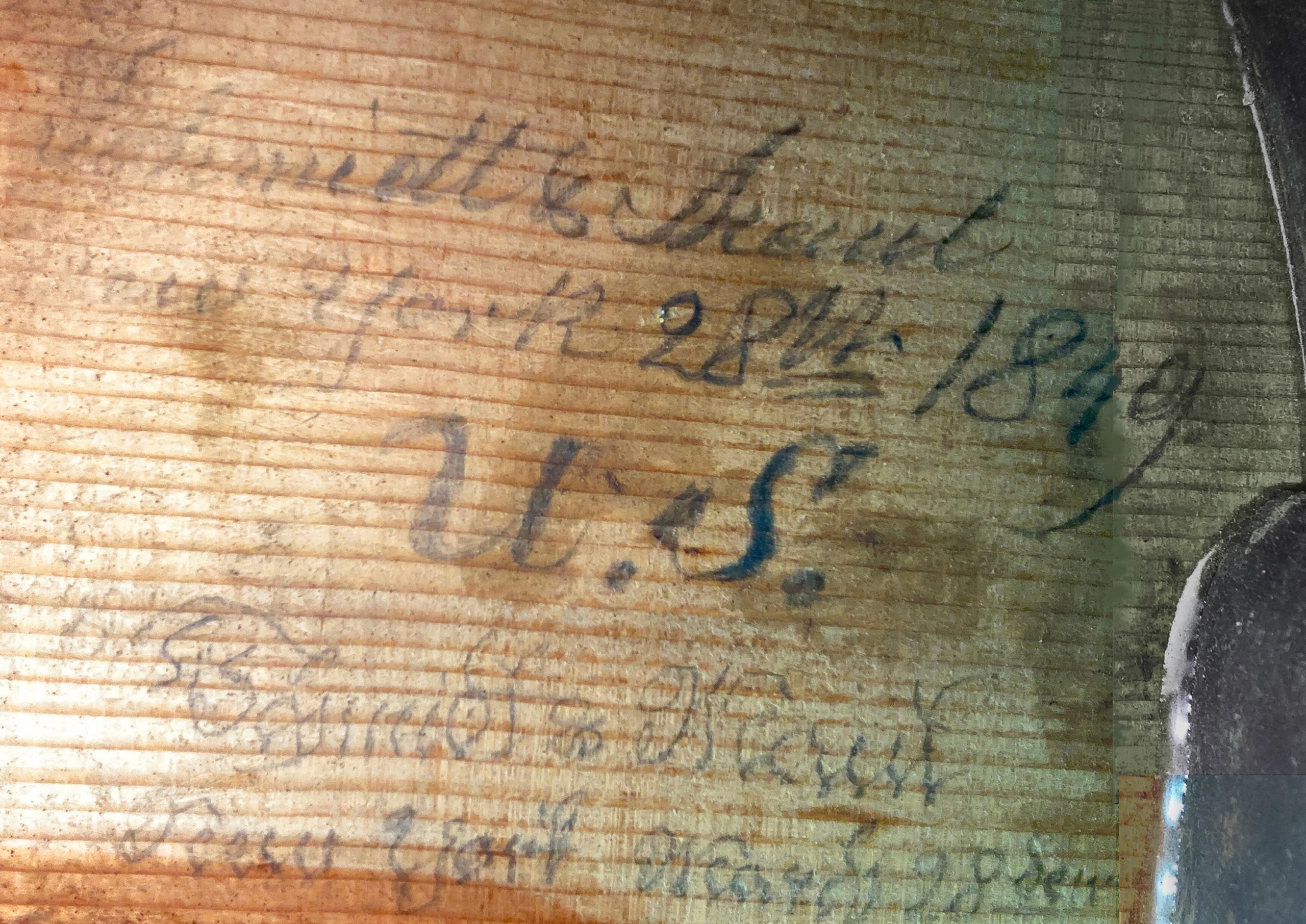
The guitar is branded inside on the neck block and center back strip, and on the outside where the back meets the heel with a stamp that reads: Schmidt & Maul New York. The interior soundboard is also signed in pencil and reads: Schmidt & Maul / New York 28th M (March) 1849 / US / Schmidt & Maul / New York, March 28th