The work of George Lewis Panormo (1815–1877) represents the final chapter in the storied history of England’s premiere guitar-making family of the nineteenth century.
George Lewis’s uncle Louis Panormo (1784–1862) arrived in London from Paris with his family in or around 1789, escaping the turmoil of the French Revolution. After being trained as a violin maker, Louis opened his own workshop in 1808 and likely started making guitars by 1815 (see the 1816 Louis Panormo in this collection—the earliest extant Panormo guitar). An impressive roster of distinguished guitarists played Louis Panormo guitars, including Antonio Huerta, Phillipe Verini, Madame Sidney Pratten, and Stanislaus Sczepanowski. The legendary guitar virtuoso-composer Fernando Sor collaborated with Louis’s brother Joseph—also a guitar luthier—and mentioned Joseph in his celebrated Méthode pour la Guitare published in Paris in 1830.
Specifications
Date
c. 1867
Location
London, England
Length of Guitar
952 mm
String Length
630 mm
Upper Bout Width
240 mm
Waist Width
183 mm
Lower Bout Width
300 mm
Side Depth at Waist
94 mm
Soundboard: Spruce | Back: Coromandel | Sides: Coromandel| Details: Larger body than his uncle’s guitars
According to guitar historian James Westbrook, George Lewis may have gone to work for his uncle Louis in the 1830s and may have also been tasked with running Louis’s business at 31 High Street Bloomsbury for a brief period in the late 1840s. In 1856, a year or so after Louis closed his studio and retired, an advertisement by George Lewis appeared in The Musical Directory where he declared himself “G. L. Panormo, Successor to Louis Panormo, late of High Street, the original Maker of GUITARS IN THE SPANISH STYLE, AND VIOLIN MAKER, 87, JOHN STREET, TOTTENHAM COURT ROAD, LONDON.”
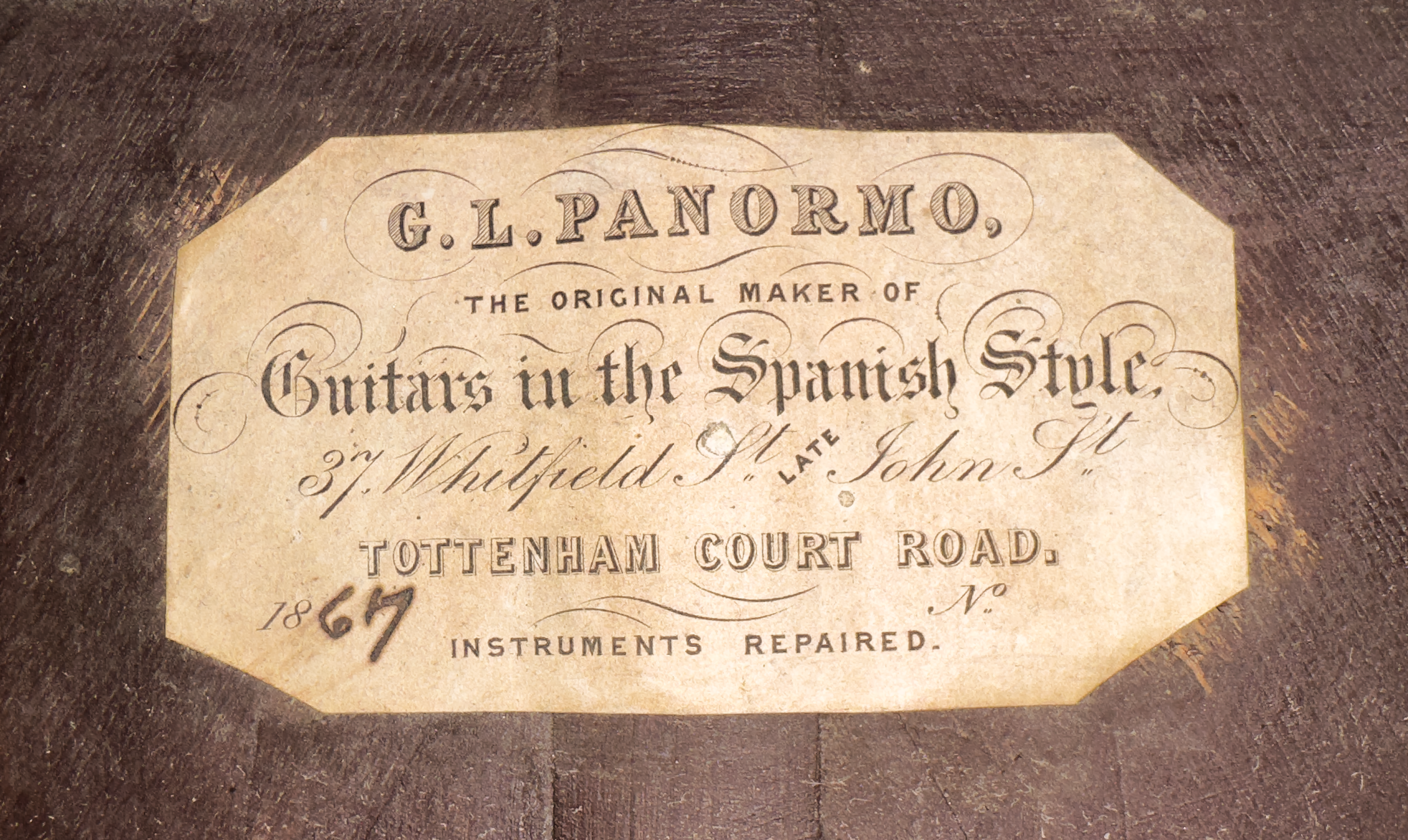
The 1867 George Lewis Panormo guitar in this collection is one of a dozen or so surviving guitars from this maker, although we can surmise from serial numbers written on some of his labels that his output was considerably greater. His uncle’s influence is immediately recognizable: the signature Panormo crescent-shaped headstock, the tuning machines by Baker, the pin bridge with mother-of-pearl bridge wings, and the rosette’s offset square and diamond shaped mother-of-pearl inlay pattern with a concentric outer circle of thin bands matching the soundboard purfling. Other attributes more distinct to George Lewis’s work would include the four-piece back made of highly figured coromandel, the generally larger plantilla (only seen on Louis’s later instruments), the one-piece spruce soundboard, the extended bridge, and the use of eight internal fan braces asymmetrically arranged (four on the treble side, one centered, and three on the bass side). The label reads: G. L. Panormo, THE ORIGINAL MAKER OF Guitars in the Spanish Style, 37 Whitfield St. LATE John St. TOTTENHAM COURT ROAD, 1867 INSTRUMENTS REPAIRED. (The abbreviation “No.” appears on the bottom right but no serial number is given.)
George Lewis died in 1877, marking the end of the Panormo guitar-making dynasty. Westbrook points out in Guitar Making in 19th Century London that Edward Panormo, George Lewis’s cousin, continued working in the musical instrument business for another 14 years following George Lewis’s death, but there is no evidence to suggest he made guitars.