
The diminutive c. 1650 Italian five-course guitar in the Austin-Marie Collection is yet another example of what scholars often refer to as a “high-A” guitar: the treble voice in a Baroque-era guitar ensemble that was tuned a 4th higher than a standard-sized instrument. Sometimes dubbed a chitarriglia, Carlo Calvi first coined the term in his 1646 publication, Intavolatura di chitarra e chitarriglia, referring to a smaller-sized, higher-pitched guitar.
As the guitar transitioned from four courses to five near the dawn of the seventeenth century, its role as an instrument for strumming, or rasgueado, differentiated it from the plucking technique, or punteado, of the vihuela. The simple raising of the third string a half step (g on a guitar vs. f# on a vihuela) easily facilitated the playing of harmonic chords. Indeed, Richard Savino, founder of the early music ensemble El Mundo and member of the Cambridge Consortium for Guitar Research, contends the guitar’s tuning convention helped pave the way for modern harmony (see part VI): https://austinmarieguitars.com/exploring-three-centuries-of-guitar-2/
| Specifications | |
| Date | c. 1650 |
| Location | Italy |
| Length of Guitar | 747 mm |
| String Length | 498 mm |
| Upper Bout Width | 148 mm |
| Waist Width | 130 mm |
| Lower Bout Width | 187 mm |
| Side Depth at Waist | 87 mm |
| Soundboard: Spruce | Back: Yew | Sides: Yew | Details: chitarriglia | |
The first half of the seventeenth century saw the five-course guitar develop in Spain and blossom in Italy. Appropriately known in Italy as the chitarra spagnuola, there were a number of publications for guitar accompanying voice and in ensemble. As the century wore on, the guitar developed into a solo instrument combining punteado and rasgueado styles as found in works by Foscarini, Corbetta, and Sanz. (See Damián Martin-Gill, The Classical Guitar in Spain, Portugal, Italy & Germany. A General Approach to Its History for a detailed account of the guitar in the seventeenth century.) https://www.musicadanza.es/contenidos/the-classical-guitar.pdf
The anonymous c. 1650 chitarriglia was originally dated c. 1645 and attributed to Giovanni Smit of Milan (likely via Füssen, Germany) by a previous owner, Harvey Hope (1943–2014). Hope was an editor and writer for Classical Guitar magazine from 1982–2002 and during his career, amassed an impressive collection of mainly seventeenth-century guitars. (See the 1652 Alexandre Voboam in this collection previously owned by Hope.)
Hope’s dating and attribution to Smit was based on similarities (as he saw them) with two Smit guitars on display at the Kunsthistoriches Museum in Vienna. Upon entering the Austin-Marie Collection, a detailed analysis of the tree ring markings on the soundboard was performed by Peter Radcliff Dendrochronology Ltd. and it was determined that the guitar likely dates from the 1650s, very close to Hope’s estimate.
However, the attribution to Giovanni Smit was highly suspect. Renowned luthier and organologist Alexander Batov was tasked with restoring the instrument and found no branding or label inside the guitar. Additionally, an empirical comparison to the Smit guitars in Vienna does little to convince the observer of an association with Smit. Therefore, the skilled luthier who made the c. 1650 diminutive guitar in this collection shall remain anonymous.
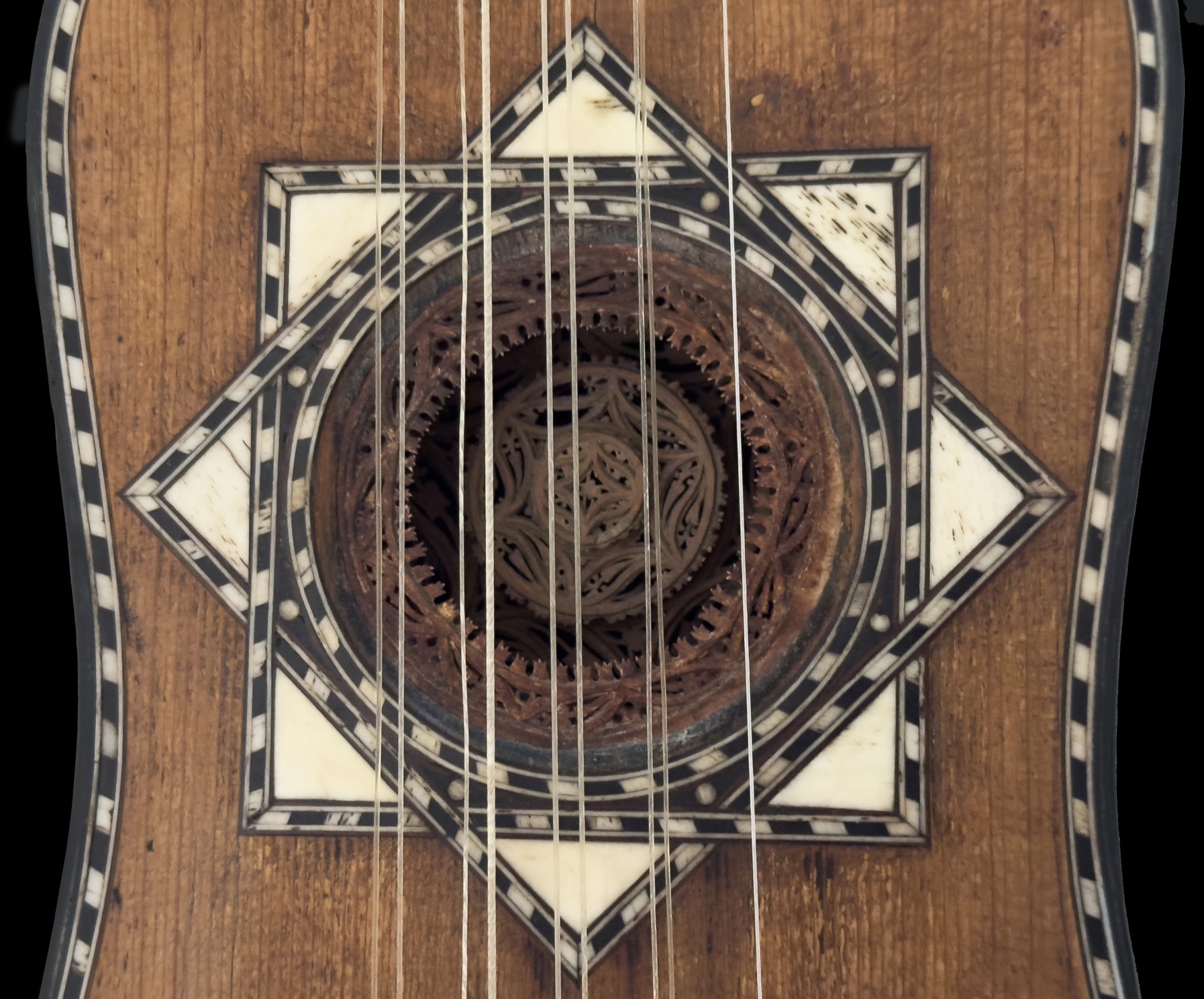
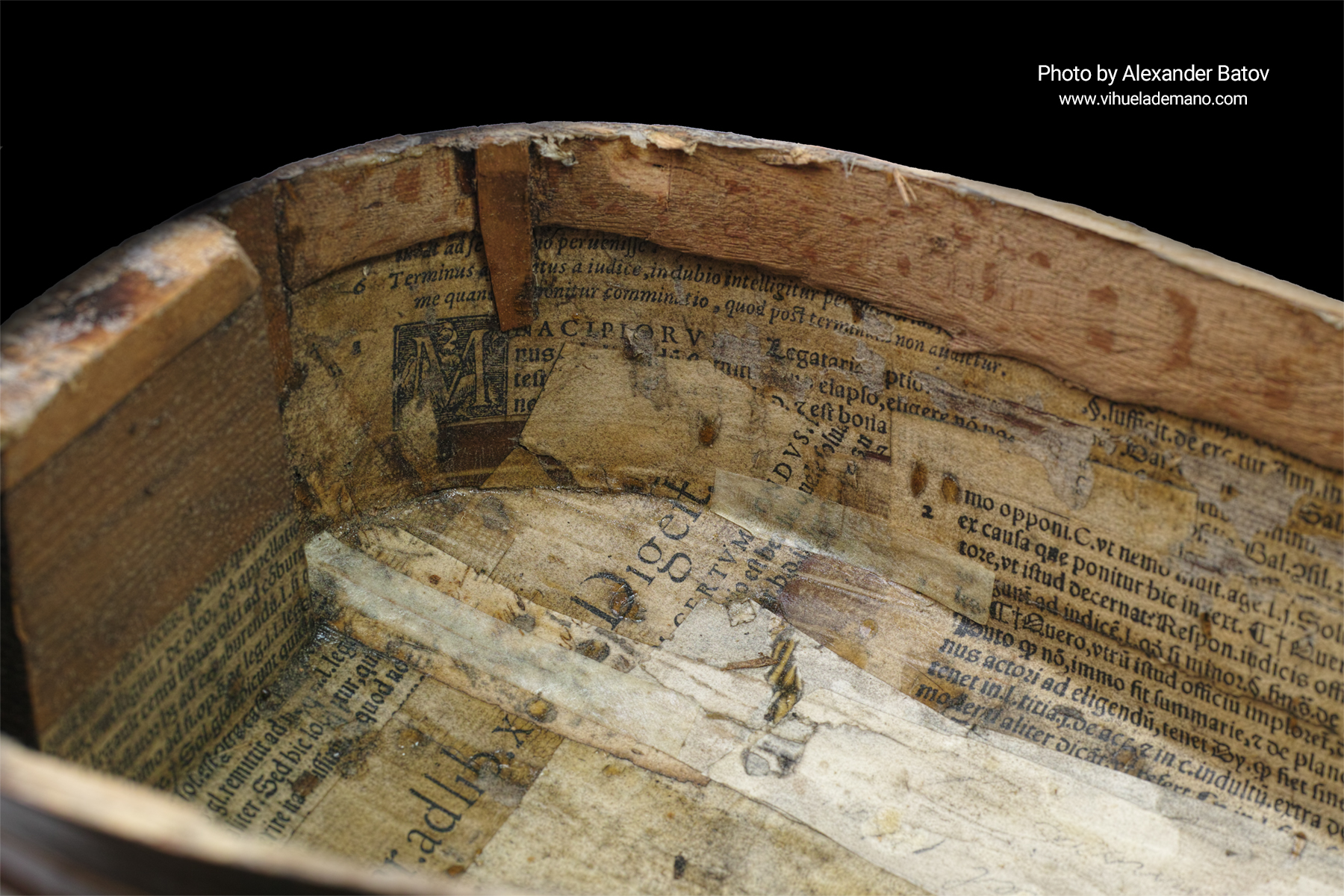
The chitarriglia has a bowl back and sides made of yew with scalloping between the ribs, separated by bone strips. The soundboard is spruce with foliate decorations of ebony and a rosette of bone and ebony. A delicate, multilayered sunken parchment rose fills the soundhole. The fretboard is inlaid bone and ebony with gut frets. The back of the neck and headstock are veneered with columns of parallelogram shapes using small, alternating pieces of bone and ebony. The headstock is fitted with 10 wooden tuning pegs to accommodate five courses. An interesting side note appears in The Hope Collection book, published posthumously in 2016: the guitar’s interior linings of parchment (please see the photo gallery) were determined by the British Library to have come from pages taken from a sixteenth-century edition of Commentaria in Corpus Juris Civilis by Bartolus de Saxoferrato (1313–1357). Saxoferrato’s work was a review of Roman jurisprudence from the time of Emperor Justinian I in the sixth century.
