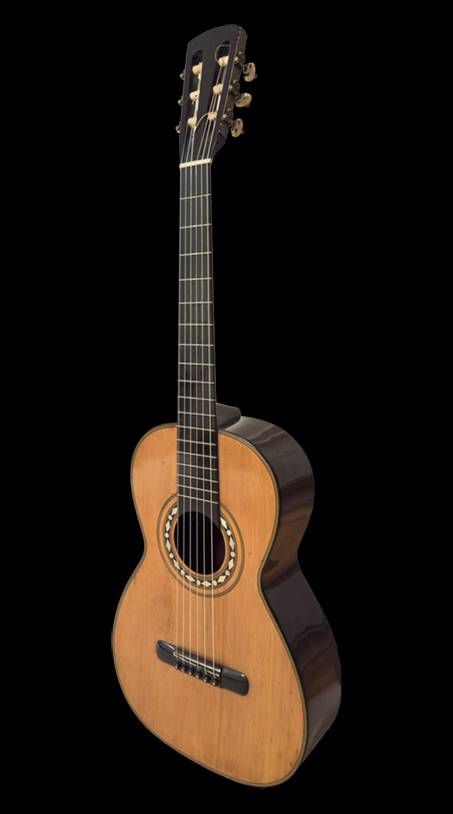
The Roudhloff brothers, Dominique and Arnaud, arrived in London from Mirecourt in Northeastern France sometime around 1830. Born into a family of guitar makers, they learned the luthier craft from their father, Charles, and uncle, François. Upon arriving in London, they likely worked for other musical instrument makers, with strong evidence showing that Dominique was employed by Johanning & Ferry, a full-line musical instrument manufacturer. By 1839, they had opened their own workshop on Charlotte Street in the Marylebone district in London’s West End. They continued making guitars until handing their business over to Charles Boullangier in 1857.
Under the label D. & A. Roudhloff, the brothers manufactured French-style guitars (see the c. 1840 D. & A. Roudhloff guitar in this collection), featuring filigree bordering the soundboard and a matching rosette typical of Parisian-made instruments. Signature Roudhloff design elements included a dome-shaped headstock, a turned-down three-point bridge, and an ebony dowel securing the neck to the body. The Roudhloffs became Panormo’s chief competition in London during the guitar craze that swept through the UK and Europe in the early nineteenth century.
| Specifications | |
| Date | c. 1850 |
| Location | London, England |
| Length of Guitar | 960 mm |
| String Length | 630 mm |
| Upper Bout Width | 240 mm |
| Waist Width | 190 mm |
| Lower Bout Width | 320 mm |
| Side Depth at Waist | 100 mm |
| Soundboard: Spruce | Back: Brazilian rosewood | Sides: Brazilian rosewood| Details: Larger body than typical of the period; X-braced | |

Their most notable contribution to guitar-making history was arguably a model they branded the “Melophonic” (a coined term meaning “melodious sounding”). The Melophonic was a larger-sized guitar that produced greater volume and projection than was typical for the period—likely a response to contemporary criticism that the soft-spoken guitar was best suited for the parlor in an era dominated by the grand piano and large Romantic orchestra.
At first glance, the Roudhloff Melophonic appears rather plain, lacking the ornate inlays typical of their French-style guitars. The rosette is a simple lozenge-and-dot design enclosed by concentric wooden bands—a pattern also used by Panormo and a century earlier by Antonio Stradivari as purfling on selected violins. The Melophonic’s plantilla is clearly larger, rivaling the size of later modern-era guitars made by Antonio de Torres. However, it is the Melophonic’s internal bracing that marks a revolutionary pivot in guitar-making history. The Roudhloffs added a large X-brace to support the soundboard, departing from the traditional ladder bracing used on the Continent and fan bracing typically seen on Spanish-made guitars.
James Westbrook, in his comprehensive work Guitar Making in Nineteenth-Century London, speculates that the Roudhloffs may have deployed an X-brace to compensate for higher-tension strings being introduced at the time, including gut-core strings wound in metal. However, it is America’s Martin Guitar Company that has long been associated with the X-brace. Martin began using it in the 1840s and still does today.
This raises the question: who was the first guitar luthier to deploy the X-brace? Here, the plot thickens. Westbrook notes that rudimentary forms of x-bracing predate both Martin and Roudhloff, citing examples from the popular late eighteenth-century “English guittar,” a pluck stringed instrument strung with wire and resembling a Renaissance cittern. (See the c. 1775 John Preston English guittar in this collection.) Could the Roudhloffs have drawn inspiration from English guittar makers?
Martin began using X-bracing in their Size 1 guitar, introduced in 1843. It was dubbed the “De Goñi” model after the Spanish virtuoso Madame Maria Dolores de Goñi (1813–1892), who arrived in New York City in November 1840. Prior to her arrival, she had performed to great acclaim in Paris and later London where she resided in 1839–1840. The Roudhloffs were reportedly a favorite maker of hers, and it is speculated she may have brought a Melophonic guitar with her to America.
Madame de Goñi crossed paths with Martin in Cherry Hill, Pennsylvania. According to the story, Martin took her “Spanish” guitar and built a similar instrument, but used X-bracing rather than traditional fan bracing. Notably, though, Madame de Goñi arrived in America not from Spain, but from England—further evidence suggesting the Roudhloffs may have introduced the x-brace to guitar making.
Additional evidence includes the nearly identical size and shape of the Melophonic and Martin’s Size 1, both unlike any Spanish guitars produced during this period.
Could the Melophonic and the Martin Size 1 represent a rare coincidence of “organological convergent evolution”? While not impossible, it seems unlikely. The first circumstantial evidence of the Melophonic dates from an 1842 Giulio Regondi concert review—the year before Martin’s Size 1 debuted. However, it must be noted that only about 20 of the 27 extant Melophonic guitars are X-braced, and none bear dated labels.
Further complicating attribution is the Roudhloffs’ business association with Henry Barelli, a luthier and string manufacturer, who may have authored the Melophonic design. If Barelli did create the Melophonic, it remains unclear whether the Roudhloffs contracted with him to manufacture it or were simply inspired by his work.
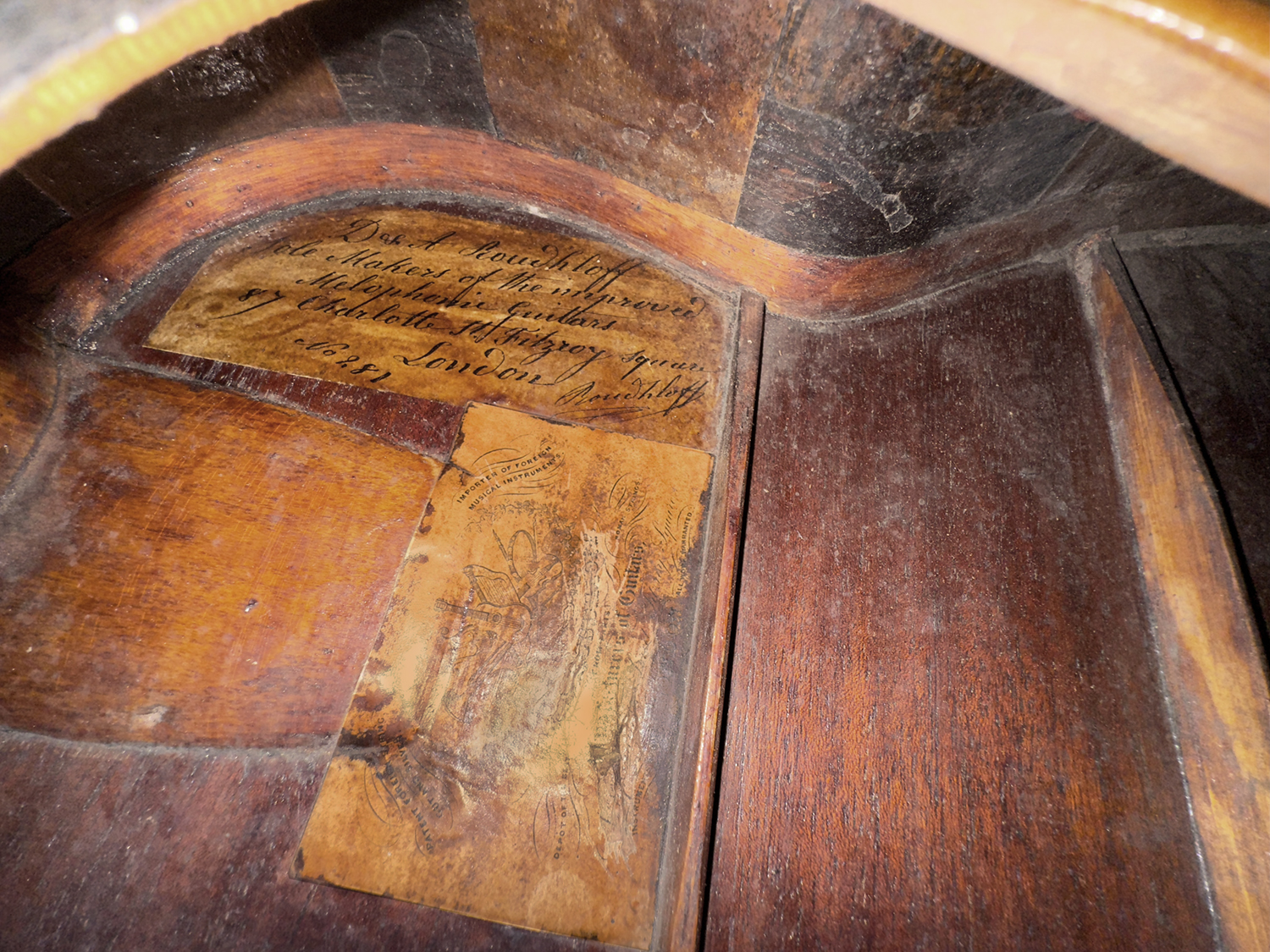
The c. 1850 Roudhloff Melophonic guitar in this collection features highly figured Brazilian rosewood back and sides and a spruce soundboard reinforced by an X-brace. The rosette consists of an outer orbit of four tightly spaced bands and two like concentric inner bands encircling an alternating dot-and-lozenge motif of mother-of-pearl. The soundboard is bordered with the same four-band pattern. The guitar is fitted with the Roudhloff’s compensation bridge featuring two saddles, one straight and another angled behind it. The rear saddle was the one used and may have been angled to address the stress from higher tension strings. The guitar is in near perfect condition with its original finish and no signs of repair. The inner label reads:
“D. & A. Roudhloff, Makers of the improved Melophonic Guitars, 87 Charlotte St. Fitzroy Square, London, No. 281.”
For a detailed analysis of the Roudhloff’s Melophonic guitar, I recommend James Westbrook’s, Guitar Making in Nineteenth-Century London: link