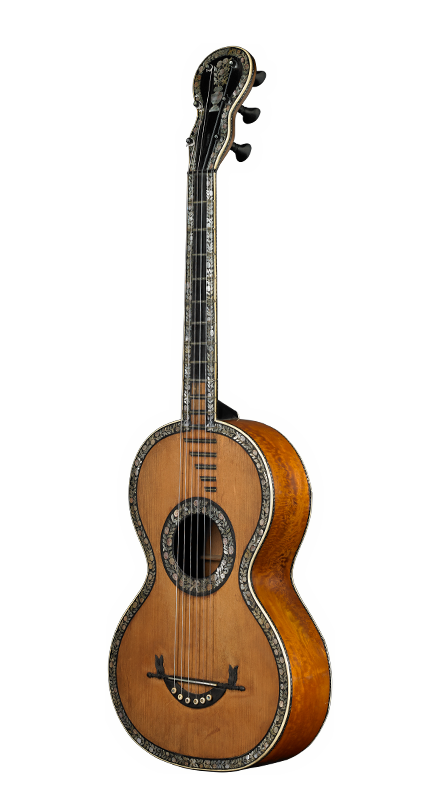
Nicolas Simoutre (1798–1870) was born in Mirecourt in northeastern France. He studied in Paris under the famed violin maker Nicolas Lupot, known as the “French Stradivari.” He returned to his hometown of Mirecourt in 1817 to establish his own atelier. As his son, the successful violin maker Nicolas Eugene Simoutre would later write, his father was a shy man who shunned the bustling lifestyle of the capital.
Specifications
Date
c. 1830
Location
Mirecourt, France
Length of Guitar
925 mm
String Length
637 mm
Upper Bout Width
235 mm
Waist Width
166 mm
Lower Bout Width
300 mm
Side Depth at Waist
85 mm
Soundboard: Spruce | Back: Maple | Sides: Maple | Details: The head is embellished with a mother-of-pearl inlay depicting a Grecian urn
Simoutre turned to crafting fine guitars, some branded with his name and many that were not. By the late 1830s, the guitar craze that had swept throughout Europe was on the decline and as demand predictably retreated, Simoutre moved north to Metz in and around 1844 to once again build violins and cellos. For the remainder of his career, Simoutre focused exclusively on crafting bowed instruments, leaving his guitar-building days behind him.
The c. 1830 Nicolas Simoutre in the Austin-Marie Collection is branded with his name visible through the soundhole on the inside of the maple back. The rosette and border of the soundboard are adorned in a matching mother-of-pearl vine motif that continues up the neck and encircles the headstock. The head is embellished with a mother-of-pearl inlay depicting a Grecian urn—a signature motif found on many of Simoutre’s guitars.