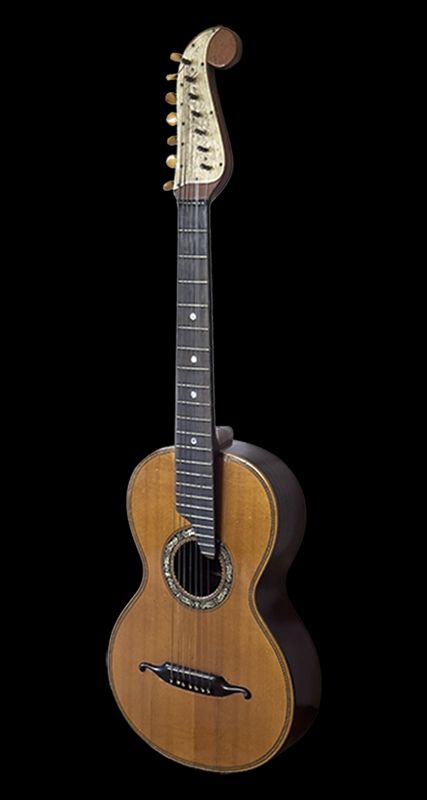
The emergence and development of the Russian seven-string guitar has often been credited to composer, virtuoso, and teacher Andrei Sychra (c. 1773–1850). Sychra was born in Vilnius, Lithuania and later worked in Moscow and St. Petersburg. He is often cited as the instrument’s patriarch, if not its inventor.
Specifications
Date
c. 1899
Location
St. Petersburg, Russia
Length of Guitar
980 mm
String Length
625 mm
Upper Bout Width
245 mm
Waist Width
182 mm
Lower Bout Width
306 mm
Side Depth at Waist
82 mm
Soundboard: Spruce | Back: Brazilian rosewood veneer| Sides: Brazilian rosewood | Details: Fitted with an encased scroll-shaped headstock with inline tuners and an adjustable neck
The Russian guitar is tuned to an open G-chord and Sychra’s background as a trained harpist may explain the harp-like textures found in his guitar works. Often incorporating stylistic and thematic similarities with the balalaika used in the performance of Russian folk music, the seven-string guitar’s open tuning and unique musical language gave it a distinctly different sonority than that of its Western-European, six-string counterpart. Other leading composer-players during the instrument’s “Golden Age” in the first half of the nineteenth century include Mikhail Vysotsky, Semion Aksionov, Vasily Sarenko, and Aleksandr Vetrov.
Julius Heinrich Zimmermann (1851–1923) was a successful German-born manufacturer of musical instruments who began work in and around 1876 in St. Petersburg and later expanded his business to include Moscow, Leipzig, London, and Riga. Over the years, his operations evolved into a full-line manufacturer of musical instruments, offering wind, brass, keyboard, and string instruments. He rose to prominence in Russia, evidenced by being bestowed with the “Order of Saint Stanislaus” by Tsar Nicholas II in 1901. With the onset of World War I, the Bolsheviks nationalized his Russian-based operations and his business was driven primarily from his headquarters in Leipzig. The Zimmermann company is still in business today as a music publisher, terminating its musical instrument manufacturing business in 1933.
According to guitar historian James Westbrook, the Zimmermann guitar in the Austin-Marie Collection was a high-end offering made for the Russian market, and likely their concert model 5209 from around 1899. The soundboard is made of spruce and the back is veneered with a single piece of Brazilian rosewood, with sides of solid rosewood. Luxury inclusions feature a scroll-shaped headstock with encased in-line tuners inspired by the Viennese makers from over half a century earlier. The neck is of mahogany with 22 frets and fitted with a Stauffer-style adjustable neck mechanism operated by a slotted-key insert in the heel. (Please see the c. 1828 Johann Georg Stauffer guitar in this collection.) The rosette is elegantly inlaid with mother-of-pearl in a fleur-de-lis-inspired design. The soundboard purfling is a meandering vine motif bound in a strip of ivory. The pin bridge is likely unoriginal.