Gérard Joseph Deleplanque (1723–1784) was born in Lille, France just south of the Franco-Belgian border. Through the invaluable work of Hemmy, Bruguière, and Echard in their 2018 paper published in the Galpin Society Journal, “New Insights into the Life and Instruments of Gérard Joseph Deleplanque, Maker in Eighteenth-Century Lille,” we now have a better understanding of the life and work of this notable French luthier.
Deleplanque was born into a musical family and began his career at the age of 12, apprenticing under the master sculptor Pierre Antoine Fremin. By the age of 19, he was certified as a master craftsman. He was a longstanding member of the image carvers’ guild and was identified as a wholesaler throughout his career, but it wasn’t until he reached his mid-30s in 1758 that public records indicate he was employed as a luthier.
| Specifications | |
| Date | c. 1770 |
| Location | Lille, France |
| Length of Guitar | 935 mm |
| String Length | 628 mm |
| Upper Bout Width | 208 mm |
| Waist Width | 175 mm |
| Lower Bout Width | 260 mm |
| Side Depth at Waist | 98 mm |
| Soundboard: Spruce | Back: Maple| Sides: Maple| Details: Embellished with ebony, ivory, tortoiseshell, & mother-of-pearl | |

Deleplanque worked at various locations in Lille, manufacturing a variety of musical instruments, including bowed strings, guitars, and a cittern-looking instrument known in France as the guitare allemande. The guitarre allemande, along with its British counterpart the English guittar, was a wire-strung plucked instrument that was hugely popular in the second half of the eighteenth century in Britain and on the Continent.
Deleplanque manufactured musical instruments and sold sheet music up until his death in 1784. However, his workshop continued operating under the management of his widow, Marie Caroline Joseph Lambelin, working with their son-in-law, Pierre Joseph Peerins. Peerins continued to make instruments under the Deleplanque label but the atelier eventually closed following his death in 1819.
Peerins likely learned the luthier’s craft when he began working for his father-in-law in 1767. His background was in watchmaking, which might partly explain why 30 of the 70 or so surviving Deleplanque instruments are citterns, with the majority fitted with a watchkey tuning mechanism, an invention sometimes attributed (but not definitively) to the English luthier, John Preston (see the c. 1775 Preston English guittar in this collection).
A total of 17 guitars attributed to the Deleplanque workshop have survived with the first dated 1761 and the last 1799. Most are fitted with five courses, typical of Baroque-era guitars, but with the emergence of guitars built to accommodate single strings in the latter part of the eighteenth century, the five-course configuration became increasingly outdated.
Deleplanque instruments were offered with a wide range of ornamentation, suggesting that some of his more ornate models may have been special orders for wealthier clientele. This is most apparent when comparing the plain-looking cittern in the Museum of the University of Leipzig to the embellished cittern in the Russian National Museum of Music, and to the highly ornate model on display at the National Music Museum in Vermillion, South Dakota.
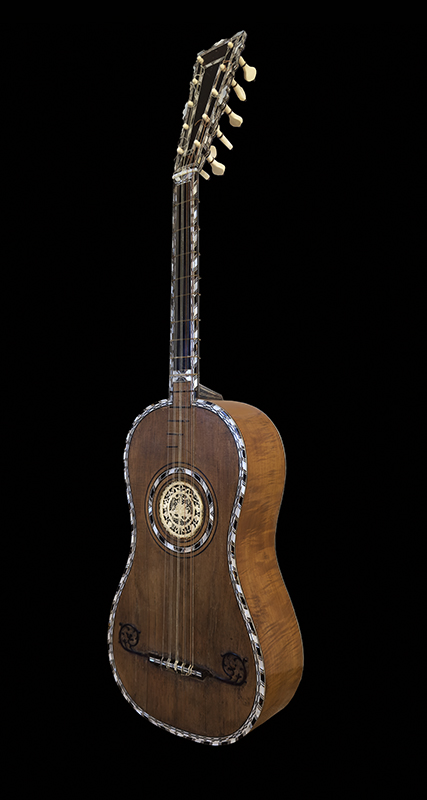
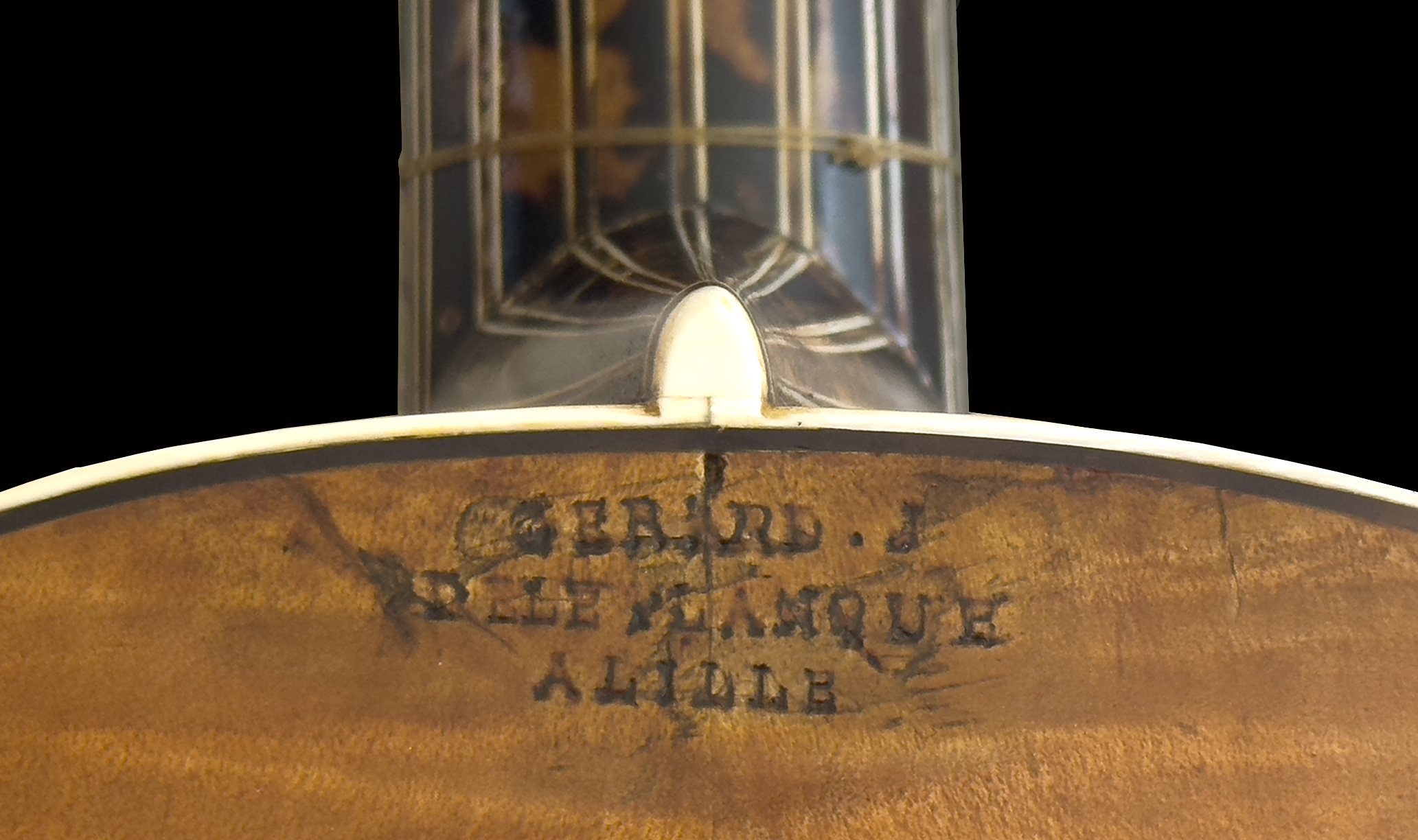
The Deleplanque five-course guitar in the Austin-Marie Collection dates from c. 1770. The soundboard is made of spruce and is outlined with a barbershop purfling design of ebony, ivory, and mother-of-pearl. This motif is typical of French Baroque-era guitars dating as far back as the seventeenth century (see the 1652 Alexandre Voboam in this collection). The bridge and its mustachios are made of tortoiseshell. The two-piece maple back and sides are bound in ivory, and the fingerboard and headstock are veneered with tortoiseshell. The rose is finely carved with ivory motifs surrounded by a rosette of four concentric ebony rings, encircling an inlay pattern matching the soundboard purfling. The purfling pattern continues up the sides of the neck, bordering and embellishing a headstock fitted with 10 ivory pegs. The neck is inlaid with parallel bone strips that extend up the back of the headstock. The guitar is branded “Gerard J Deleplanque a Lille” on the upper back side just under the heel.
Deleplanque guitars represent a crowning achievement during the historical twilight of the five-course guitar. Of the 17 extant guitars by this maker, only five are held in private collections (including the c.1770 guitar featured here) with the remaining housed in museums.