Apprentices who learned the luthier craft in Mirecourt during the nineteenth century were much sought after and would routinely move on to establish their own workshops in other cities, often Paris. Occasionally they would return to Eastern France after several years of success bringing their cultivated skills back to the various Mirecourt ateliers.
Modern day Mirecourt still embraces its legacy as a historic center for musical-instrument making: the logo on the tourism office declares, Capitale de la Lutherie. Its legacy is on display at the Musée de Mirecourt, dedicated to the art of violin and guitar making.
Joseph Victor Achille Josset (1801–1846) was born in Mirecourt and later settled in Paris. Little is known about Josset’s career, but he may have worked in both places.
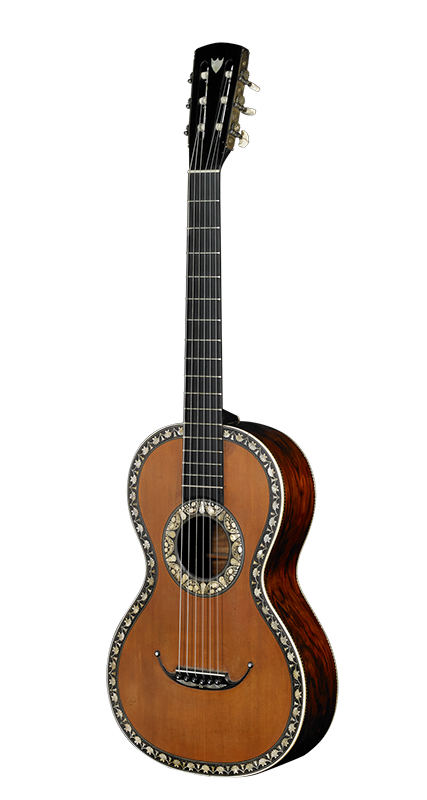
The Josset in the Austin-Marie Collection was likely made in Mirecourt and has many features typical of Mirecourt-made guitars, including the outline of the bridge and the characteristic decorative mother-of-pearl inlays bordering the soundhole and spruce soundboard. The head and neck are veneered in ebony with back and sides made of highly figured Brazilian rosewood. It may have originally come with wooden pegs but was later refitted with mechanical tuners. The French-style bracing.
This instrument is reputed to have belonged to the renowned Danish artist Anne Marie Brodersen, one of the first women to be recognized as a serious sculptor. In 1891, she married the famed musician Carl Nielsen, considered to be Denmark’s greatest symphonic composer.