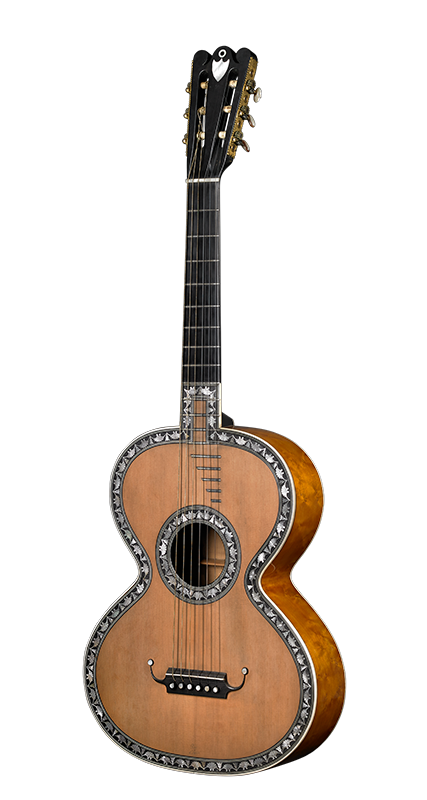
César Pons (1748–1831) of Grenoble and two (possibly three) of his eight sons, Antoine (1780–after 1835), Louis David (1786–1873), and Pierre Claude (1783–1873) established one of the foremost musical-instrument-making workshops during the first half of the nineteenth century. Together they produced many of the finest guitars and lyre-guitars for the nobility and leading virtuosos of the day.
Antoine left for Paris in 1803 and a year later opened his own atelier. He is immortalized today for his finely crafted instruments and his Paris workshop is where a young Pierre René Lacote, the most celebrated of all nineteenth-century French luthiers, honed his craft.
| Specifications | |
| Date | c. 1832 |
| Location | Paris, France |
| Length of Guitar | 900 mm |
| String Length | 603 mm |
| Upper Bout Width | 263 mm |
| Waist Width | 174 mm |
| Lower Bout Width | 333 mm |
| Side Depth at Waist | 82 mm |
| Soundboard: Spruce | Back: Birdseye maple | Sides: Birdseye maple | Details: Fitted with mother-of-pearl tuning buttons | |
It is difficult to assign a precise attribution to Pons guitars because individual family members are never specifically named on the luthier’s stamp or label. There is a five-course guitar branded “Cesar Pons A Grenoble” (the family patriarch), and another six-string guitar branded “L. Pons Grenoble” (likely by Louis David) but other Pons guitars are labeled or engraved Pons fils “son” (most likely Antoine), Pons jeune “the younger” (conjectured to be Pierre Claude), or Pons aîné “the elder” (most likely used by Antoine later in his career). There are also instruments (e.g. the c. 1832 Pons featured here) that are simply branded Pons à Paris visible through the sound hole on the inside of the back. It is speculated that the few surviving guitars marked Pons à Paris were contracted by the Pons workshop to be built in Mirecourt for sale in the Paris market.
Adding to the confusion is the misattribution to Joseph Pons by the famed early nineteenth century musicologist René Vannes (1888–1956) in his Dictionnaire Universel des Luthiers—a comprehensive resource guide for stringed instrument luthiers. Vannes contends that Joseph Pons was likely Pons fils. Unfortunately, Vannes provides no explanation as to why he believes this is the case and as it turns out, there is no existing record of Cézar’s son Joseph other than his birth certificate dated September 25, 1781. It was Joseph’s brother Antoine Pons who worked in Paris building guitars as Pons fils and went on to mentor Pierre René Lacote.
It has been confirmed that Lacote apprenticed in the Pons workshop in or around 1813, and the evidence for a Pons family member apprenticing Lacote is based not only on the similarities in their work, but also on the writing found on a Lacote label which translates to: “Lacote successor of Martin, luthier, raised by M. Pons.” It is not clear, however, if Lacote or Guillaume Martin—or both—were “raised” by Pons, and it’s possible that it was only Martin. Nonetheless, the similarities in design and craftsmanship help make the case that one of the Pons family members was, in fact, Lacote’s teacher. (Consider the decorative locking tuners on the 1834 Lacote presentation guitar in this collection—a Pons design—as another clue to the Pons-Lacote association.)
After running into financial difficulties, Antoine Pons fled Paris for London in 1818 and stayed for over a decade. Curiously, there is only a single London-made extant guitar that can be definitively attributed to him. Housed in the Musikmuseum in Basel, Switzerland, the ornate, highly embellished guitar is marked “Pons London/1819.” The question is begged: why has only one guitar verifiably made by Antoine Pons survived from his 12-year stay in London? Guitar historian James Westbrook believes it is possible that Antoine’s London-made guitars had their peg headstocks—affixed with the Pons engraved shield—removed and refitted with tuning machines. This is a plausible theory as the English were early and enthusiastic adopters of mechanical tuners, and such a modification would result in a London-made Pons losing its branding. As an example, one of the two Laprevotte guitars in this collection went through a like modification after arriving in in London, evidenced by its unoriginal headstock with machine tuners stamped “Journet of London” on the back of the head.
There is another extant guitar—lacking a maker’s mark—that may have been built by Antoine during his London period (see the the c. 1831 guitar attributed to Pons in this collection). James Westbrook, in his definitive work Guitar Making in Nineteenth-century London, surmises that Antoine trained at least one of the members of the London-based Guiot luthier family; but the workmanship of the guitar in question here, despite the similar ornate embellishments found on selected Guiot guitars, is considerably more refined. Westbrook points out that the ebony veneered neck, the way the neck is joined to the heel, and the scalloped Lacote-style bracing are all attributes typical of Pons guitars, but never seen on Guiot guitars.
Other questions remain, including who was Pons jeune, and Pons aîné?
Guitar historian Catherine Marlat has pointed out that instruments by Louis David and Pons jeune are different and distinct. It is surmised that Antoine used Pons aîné after he was able to resolve his debt issues and return to Paris in or around 1832, following the settlement of his father’s estate. (There are two extant guitars labeled Pons aîné from 1832 and 1835.) Perhaps the biggest mystery is the identity of Pons jeune, who worked in Paris during the 1820s and early ‘30s. Marlat speculates that the most likely candidate is another Pons brother, Pierre Claude (1783-1873), who may have originally worked with Antoine in Paris and built guitars under the label of Pons jeune.
An interesting chapter in the Pons family story features a highly ornate, masterfully crafted presentation guitar dated 1812 by Pons fils (Antoine) and known as the “De Monte.” It tells a romantic tale of friendship, tragedy, and discovery.
Empress Marie Louise (Napoleon’s wife) took possession of a highly ornate presentation guitar in 1812 built for her, likely by Antoine Pons, with “Pons Fils, à Paris 1812” engraved on a pearl shield affixed to the headstock. The Empress later presented the instrument to the renowned guitar virtuoso Mauro Giuliani, who was working under her patronage as a chamber virtuoso in Vienna. Giuliani, in turn, gifted the guitar in 1815 to his good friend and student, Christopher de Monte, a wealthy young English gentleman and the probable dedicatee of Giuliani’s Guitar Concerto, Op. 36.
Tragically, the 22-year-old de Monte took ill and died the following year while returning to England. His belongings, including the Pons guitar, were placed in storage at Coutts private bank in London where they remained undiscovered for some 180 years. It wasn’t until 1996 that the De Monte Pons once again saw the light of day.
The c. 1832 Pons guitar in the Austin-Marie Collection is very neatly branded Pons à Paris visible through the sound hole on the inner back and has many of the unique and defining qualities typical of a Pons guitar. The internal soundboard bracing is rather unique, with two finger braces added near the bottom of the guitar, one on each side, starting from each bout pointing toward the bridge. It has the usual first-string finger brace (necessary for all guitars with a flush fingerboard) as well as two harmonic bars, and a large diagonal brace. The plantilla is very rounded, something akin to Lacôte’s Legnani-Stauffer-inspired design. The back and sides are of the finest birdseye maple. The mother-of-pearl inlays are precisely placed and there are a few luxury inclusions, including the mother-of-pearl tuning buttons and eyelets on either side of the ribbon hole to the top of the head.
The identity of the maker of the Pons guitar in this collection is unknown. Could Antoine have contracted journeyman luthiers to build guitars for sale at his Paris workshop or even Mirecourt (a large musical-instrument-making center) in Northeastern France? There are marked similarities—but also differences—in the work of a few builders in the region of Mirecourt and the Pons in this collection. However, in the Dictionary of French Guitar Makers 1625–1875, Catherine Marlat and Erik Pierre Hofmann believe that the few surviving guitars simply branded Pons à Paris without a Pons label, were likely made in Mirecourt and designed with a shorter string length (590–600mm range) a la Sagrini. The Italian guitar virtuoso Luigi Sagrini (1809–1874) purportedly wanted the flexibility to alternate between standard E-tuning and the higher pitched G-tuning used on a smaller-scale “terz” guitar. Guitars from the 1820s and 30s most often came with a string length in the 630–640 mm range while a terz guitar’s was generally around 560 mm. A guitar with a string length in the 595–600 mm range could accommodate both tunings as the shorter string length would allow for tuning to a higher pitch. Considering the c. 1832 Pons in this collection has a strength length of just 603 mm, it’s conceivable that it was built as a Sagrini model.
The craftsmanship of the c. 1832 Pons in this collection is unparalleled and this distinction, coupled with the rarity of guitars by Pons, makes it one of the most collectable of all French guitars.