In 1732, the Duke of Lorraine, recognizing the town’s burgeoning instrument-making industry, created a charter to regulate the luthier trade. Over the next two centuries production evolved from single-family workshops, to families working together, to small factories, and by the latter part of the nineteenth century, culminated in the largest operator in France: Jérôme Thibouville-Lamy & Company, which boasted four factories and retail outlets in Paris, London, and New York.
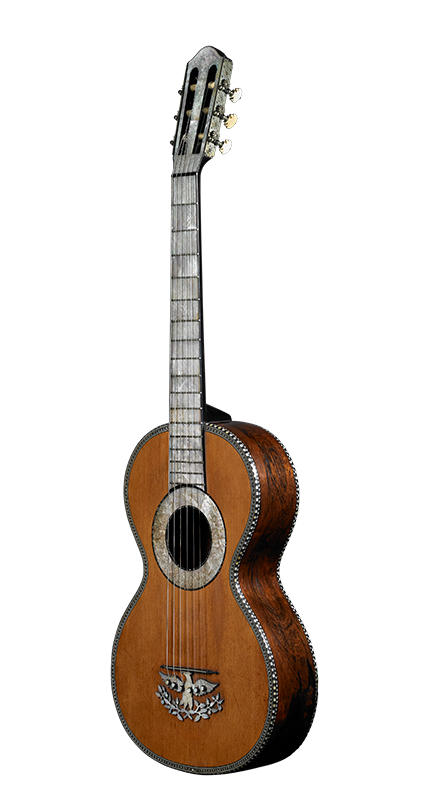
The ornate presentation guitar in the Austin-Marie Collection featuring a bridge depicting a Bald Eagle lined with stars, was built in Mirecourt. The fretboard and headstock with matching rosette are veneered with mother-of-pearl masterfully engraved with ornate filigree framing scenes of Lady Liberty, the American flag, and a shielded Bald Eagle. The back and sides are made of Brazilian rosewood.
The Americana themes may seem out of keeping with a guitar manufactured in France, and adding to the mystery is the absence of a luthier’s label or stamp identifying the maker. Guitars made in Mirecourt were frequently unmarked but when they were, the family name was often used, making an exact attribution more difficult. Fortunately, most families and larger operators had telltale design and construction styles that make for easier identification. The “Americana” guitar in this collection has all the hallmarks of the guitars made in the workshop of Aubry Maire.
In 1824, Joseph Aubry (1800–1867) a luthier born and trained in Mirecourt, married Jeanne Maire and subsequently built guitars under the brand name of “Aubry Maire.” The Aubry Maire workshop developed a reputation for producing highly decorative instruments which —as Erik Pierre Hofmann and Catherine Marlat have suggested in their definitive work, The Dictionary of French Guitar Makers 1625–1875, “sometimes gained the upperhand over musical qualities.” Nevertheless, the Aubry Maire workshop influenced a generation of Mirecourt luthiers, arguably setting the standard for visual artistry.
Typical design elements found in guitars by Aubry Maire are clearly evident in the c. 1855 guitar. These include a spruce soundboard, rosewood back and sides, a fretboard and headstock veneered with engraved mother-of-pearl with matching rosette, a dome-shaped head, a V-shaped neck-to-head joint, and internal braces that taper from the center to where they intersect the linings.
Dating the Aubry Maire guitar is more of a challenge. The Americana themes and ornate embellishments suggest it may have been a special order for an American client. It may have also been a presentation guitar for display at a major international event like the Exposition Universelle held in Paris in 1855. We can only speculate.