
Antoine Pons (1780–after 1835) was the most celebrated member of the renowned Pons family of musical-instrument makers who inspired a generation of luthiers in the first half of the nineteenth century. Born in Grenoble into a large family of 15 children, he was trained by his father César who ran a successful workshop building a variety of musical instruments.
Records confirm that by age 20, Antoine had declared himself a luthier. It is surmised that he left Grenoble for Paris in or around 1803 and likely began work as a journeyman before establishing his own workshop in the fall of 1804. It is documented in period directories that he was working in Paris as Pons fils (son) by 1811. However, evidence points to an earlier date as a lyre guitar on exhibit at the Boston Fine Arts Museum is marked “Pons Fils Paris 1810.”
| Specifications | |
| Date | c. 1831 |
| Location | London, England |
| Length of Guitar | 948 mm |
| String Length | 648 mm |
| Upper Bout Width | 240 mm |
| Waist Width | 173 mm |
| Lower Bout Width | 310 mm |
| Soundboard: Spruce | Back: Brazilian rosewood laminated onto spruce | Sides: Brazilian rosewood | Details: Ornate presentation with quality materials and Baker tuners | |
The next of Antoine’s noteworthy creations came a short time later in the famous “De Monte Pons” built for Napoleon’s second wife, Empress Marie Louise. The Empress later presented the highly embellished guitar (marked “Pons Fils, à Paris 1812” on an engraved mother-of-pearl shield affixed to the headstock) to the renowned guitar virtuoso Mauro Giuliani, who was working under her patronage as a chamber virtuoso in Vienna. Giuliani, in turn, gifted the guitar in 1815 to his good friend and student, Christopher de Monte, a wealthy young English gentleman and the dedicatee of Giuliani’s Guitar Concerto, Op. 36.
Tragically, the 22-year-old de Monte took ill and died the following year while returning to England. His belongings, including the Pons guitar, were placed in storage at Coutts private bank in London where they remained undiscovered for some 180 years. It wasn’t until 1996 that the De Monte Pons once again saw the light of day.
Antoine has also been credited with mentoring the most famous of all nineteenth-century French guitar makers, Pierre René Lacote. It has been confirmed that Lacote worked in the Pons workshop in or around 1813, and the evidence for apprenticing Lacote is based not only on the similarities in their work, but also on the writing found on a Lacote label which translates to: “Lacote successor of Martin, luthier, raised by M. Pons.”
Antoine’s fortunes took a turn for the worse in 1818: when facing arrest for failing to pay a substantial debt, he fled to London where he remained for the next 12 years.
Antoine’s London period is a mystery as there exists very little evidence of his whereabouts or work. The fact that there is only a single London-made extant guitar that can be definitively attributed to him has led to considerable speculation. Housed in the Musikmuseum in Basel, Switzerland, the ornate, highly embellished guitar in question carries an engraved shield on the head that reads “Pons London 1819.” Guitar historian James Westbrook believes it is possible that Antoine’s London-made guitars had their peg headstocks—affixed with the Pons engraved shield—removed and refitted with tuning machines. This is a plausible theory as the English were early and enthusiastic adopters of mechanical tuners, and such a modification would result in a London-made Pons guitar losing its branding.
Antoine is described in the London Gazette of January 6, 1832—just a few months before he departed London to return to the Continent—as a “guitar maker, teacher of the guitar, and portrait painter.” He began building guitars in Paris as Pons aîne (elder) later that year. His last known guitar dates from 1835.
There is another guitar, however, that is unlabeled but arguably made by Antoine during his long stay in London: the c. 1831 anonymous guitar in this collection attributed to him and fitted with British-made Baker tuners—the same tuners favored by the leading guitar-maker in London, Louis Panormo. Baker started making tuners in 1831 and Antoine departed London in 1832, therefore we date the instrument c. 1831.
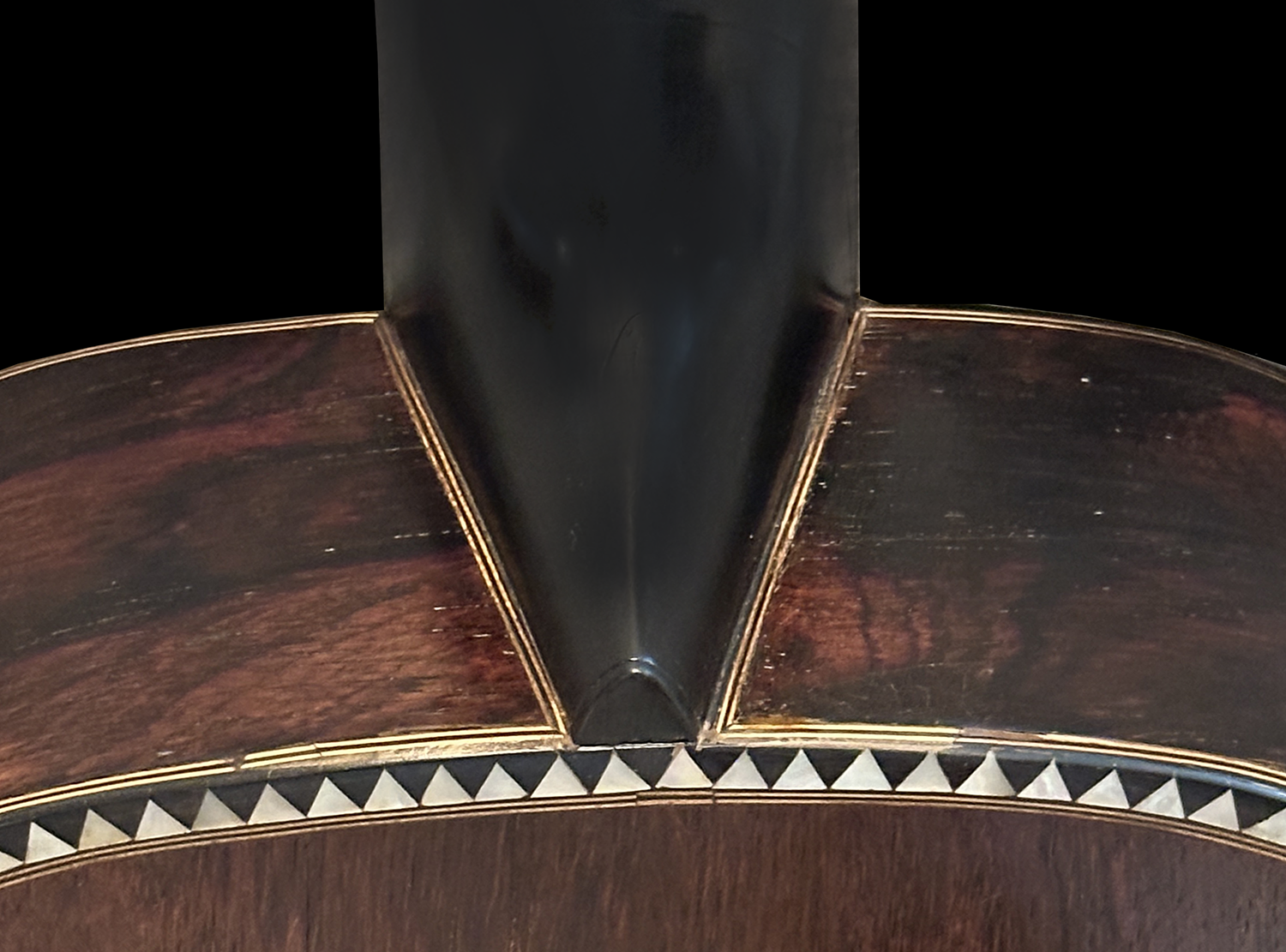
Guitar historian James Westbrook, in his definitive work Guitar Making in Nineteenth-century London, surmises that Antoine trained at least one of the members of the London-based Guiot luthier family; but the workmanship of the c. 1831 guitar attributed to Pons, despite the similar ornate embellishments found on selected Guiot guitars, is considerably more refined. Westbrook points out that the ebony veneered neck, the way the neck is joined to the heel, the scalloped Lacote-style bracing, and the back of rosewood veneered onto spruce are all attributes typical of Pons guitars—but never seen on Guiot guitars. Its London-made pedigree is confirmed with the shape of the head and Baker tuners, and the mother-of-pearl-dot fret markers inlaid into the side of the neck as opposed to the fretboard—a characteristic peculiar to London-made guitars.
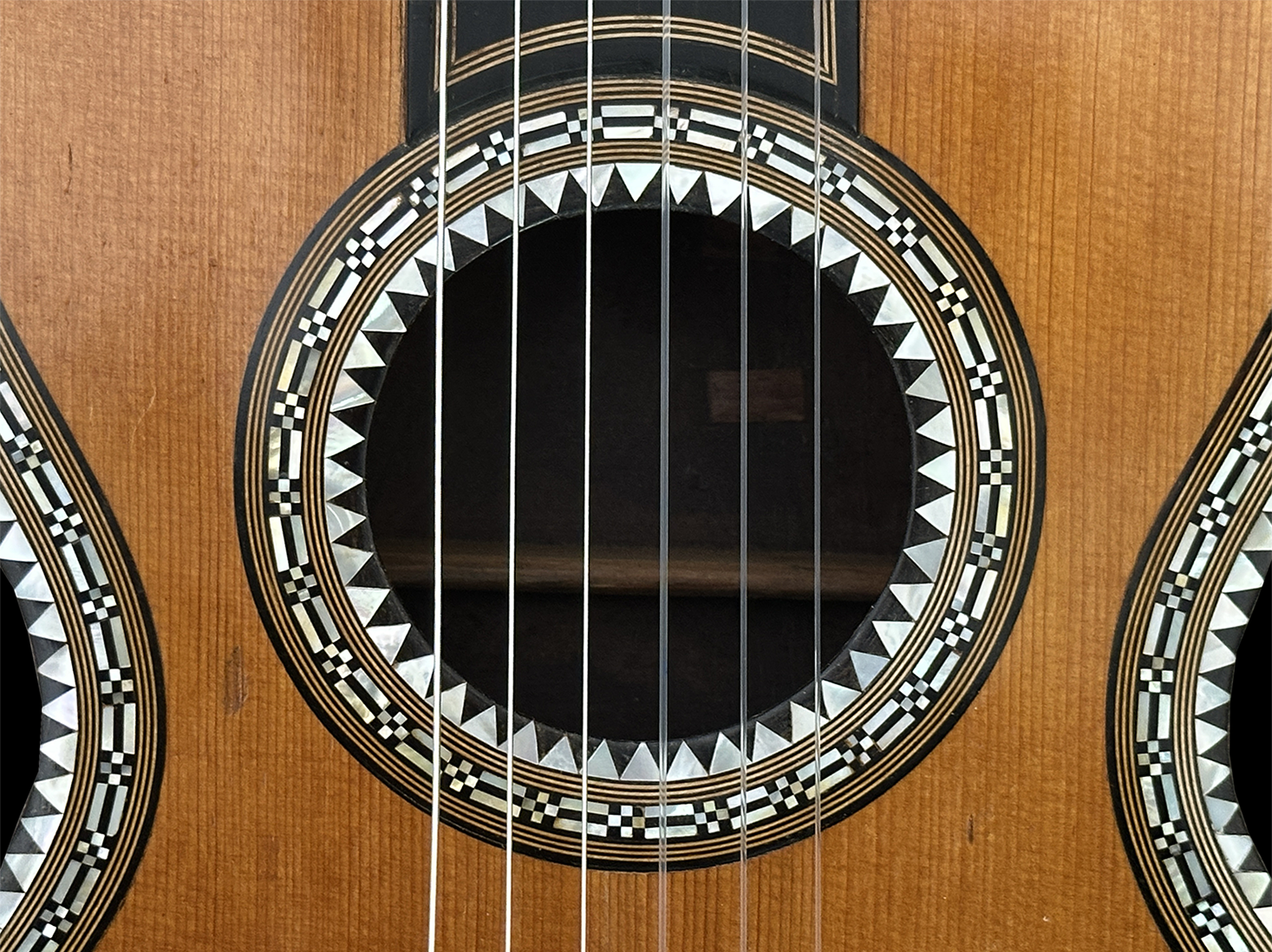
The c. 1831 guitar has a spruce soundboard with a back of Brazilian rosewood veneered onto spruce and solid Brazilian rosewood sides. The outer purfling pattern is of alternating ebony and mother-of-pearl triangles bordering both the soundboard and back. An additional intricate pattern of rectangles and squares of mother-of-pearl complete the purfling design and are framed on both sides by three light-colored wood bands inlaid into ebony. The entire ensemble serves as a matching rosette. The rectangular ebony pin bridge features mother-of-pearl teardrop wings terminating in a triangle made of mother-of-pearl dots. The sides feature bindings at the soundboard and back made of two light-colored wood bands. Three narrow inlaid bands of light-colored wood run up both sides of the fretboard and frame the headstock. There is an unmarked mother-of-pearl shield at the top of the head. The elegant mother-of-pearl button tuners are by Baker. The neck is ebony veneered. The guitar is a premium model: an exceptional instrument combining the best design elements of both French and English guitars of the period.
