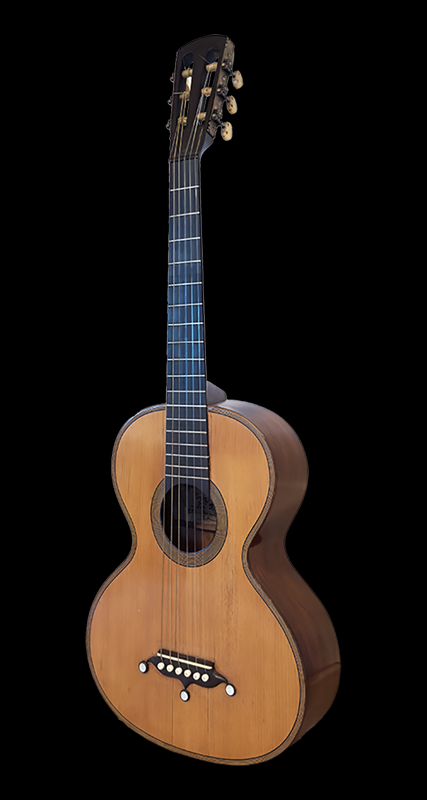
A fourth guitar owned by members of England’s iconic Pelzer family resides in the Austin-Marie Collection. It is also the third instrument in the collection constructed by the famed Roudhloff brothers Dominique (1798–1880) and Arnould (1804–1862), who arrived in London via Paris in or around 1834 and went on to establish a successful workshop, building guitars under the label “D. & A. Roudhloff.”
The Roudhloffs were a favorite maker of Madame Sidney Pratten, née Catharina Pelzer (1824–1895), a leading figure in the Victorian-era guitar scene. The young Catharina and her family immigrated to England from Prussia in or around 1830 and was promoted as a child prodigy by her father Ferdinand Pelzer, who himself built a successful career as a performer, teacher, and method writer.
| Specifications | |
| Date | c. 1840 |
| Location | London, England |
| Length of Guitar | 880 mm |
| String Length | 593 mm |
| Upper Bout Width | 244 mm |
| Waist Width | 170 mm |
| Lower Bout Width | 320 mm |
| Side Depth at Waist | 85 mm |
| Soundboard: Spruce | Back: Brazilian rosewood veneer | Sides: Brazilian rosewood | Details: French-style guitar | |
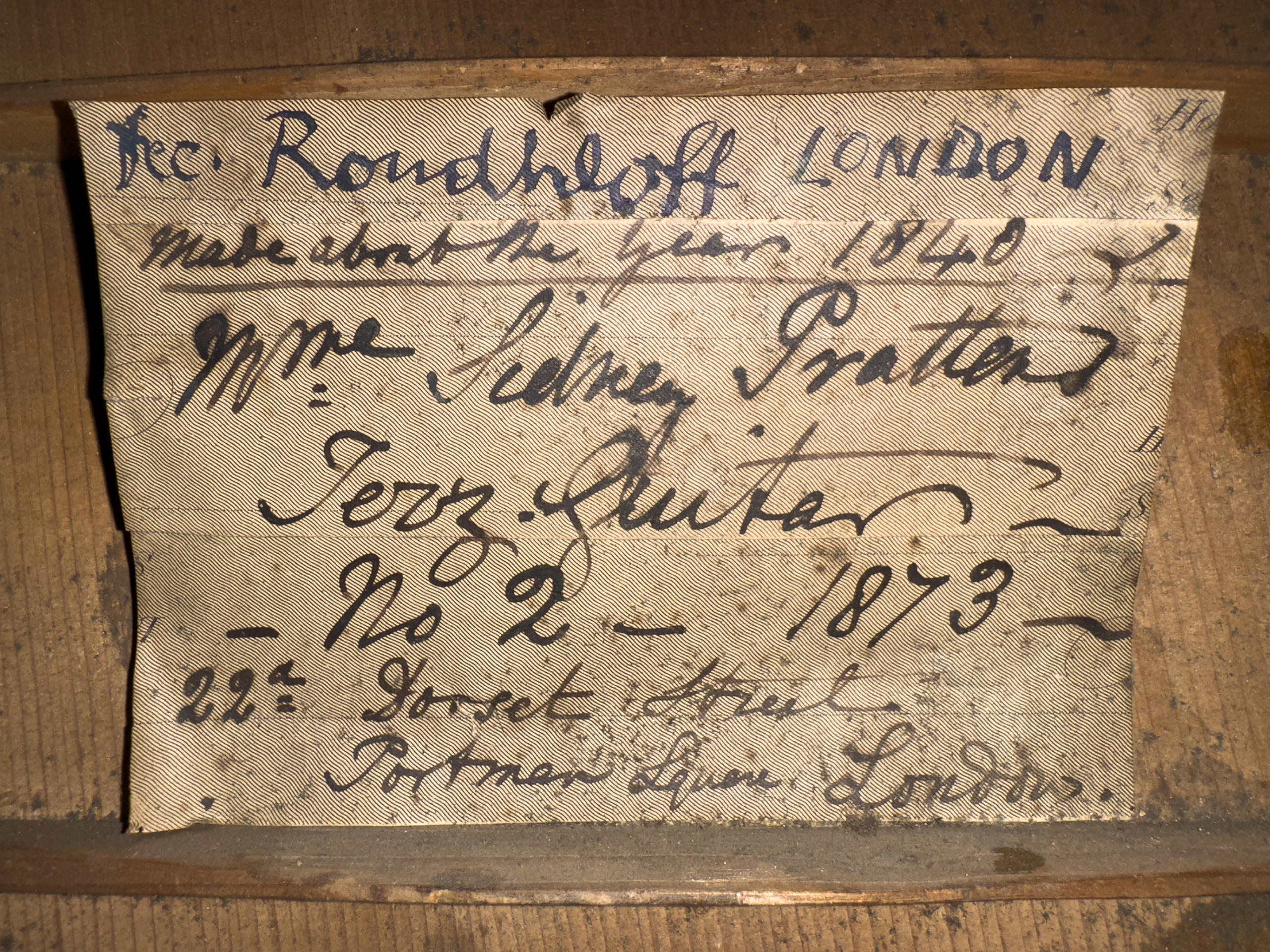

The third Roudhloff in this collection distinguishes itself from the other two—a French-style guitar and a larger-sized X-braced “Melophonic” model—by featuring a shorter string length of 593 mm as compared to an average length of 630–640 mm for guitars from the period. Madame Pratten’s own label (which overlays the Roudhloff label) includes the following:
fec. Roudhloff London
made about the year 1840
Mme. Sidney Pratten
Terz Guitar
The “terz” was a popular small-scale guitar typically constructed with a string length in the 530–560 range. Born in Vienna at the dawn of the nineteenth century, its name comes from the Italian word terza or “third,” as it was designed to be tuned a minor third higher than conventional guitar tuning. The considerably longer string length of 593 mm measured on the c. 1840 Roudhloff—while still shorter than the average string length of 630–640 mm for a guitar—begs the question as to why Madame Pratten would label her guitar a terz.
It is speculated that she used the smaller-scale Roudhloff interchangeably to perform music written for either the guitar or terz guitar. The instrument has the dimensions of a guitar à la Sagrini, named after the Italian guitar virtuoso Luigi Sagrini (1809–1874), who popularized a guitar with a string length in the 590–600 mm range suitable for both conventional and terz tuning, eliminating the need for the guitarist to capo at the third fret. The convenience of traveling with a single instrument—as opposed to two—was obvious for an artist who was required to perform music on both the guitar and terz guitar. Furthermore, the Roudhloff conforms to the shape and size dimensions of guitars constructed à la Sagrini, featuring an exaggerated hourglass plantilla and shorter neck length (see the c. 1827 anonymous French guitar and the c. 1832 Pons in this collection; both display a similar shape to the Roudhloff with a string length in the 600 mm range).
The instrument remained in the Pelzer family until the passing of Giulia King-Church (Catharina’s younger sister) in 1938 at the age of 99. Giulia’s estate was auctioned at Sotheby’s in London and the instrument appears as item #206 in the auction catalog dated December 15, 1938.
The c. 1840 Roudhloff soundboard is made of spruce with a back of Brazilian rosewood veneer and sides of solid Brazilian rosewood. The instrument features the Roudhloff’s signature turned-down, three-point pin bridge in ebony with mother-of-pearl buttons. The dome-shaped headstock contrasts with the crescent-shaped head used by Panormo, the Roudhloff’s largest competitor in the London market. The purfling and matching rosette feature tight concentric bands, a design often used by French luthiers from the period (see the c. 1827 anonymous French guitar and 1835 Lacote in this collection). The engraved brass tuners are fitted with ivory buttons. The guitar comes in its original British-red-felt-lined coffin case with an attached metal side plaque that reads “Madame Sidney Pratten.” Additionally, the guitar was formerly owned by guitarist Steve Howe of the British rock band “Yes.” It appears on page 57 (misattributed as an “anonymous French guitar”) of the 1993 of edition of The Steve Howe Guitar Collection book.