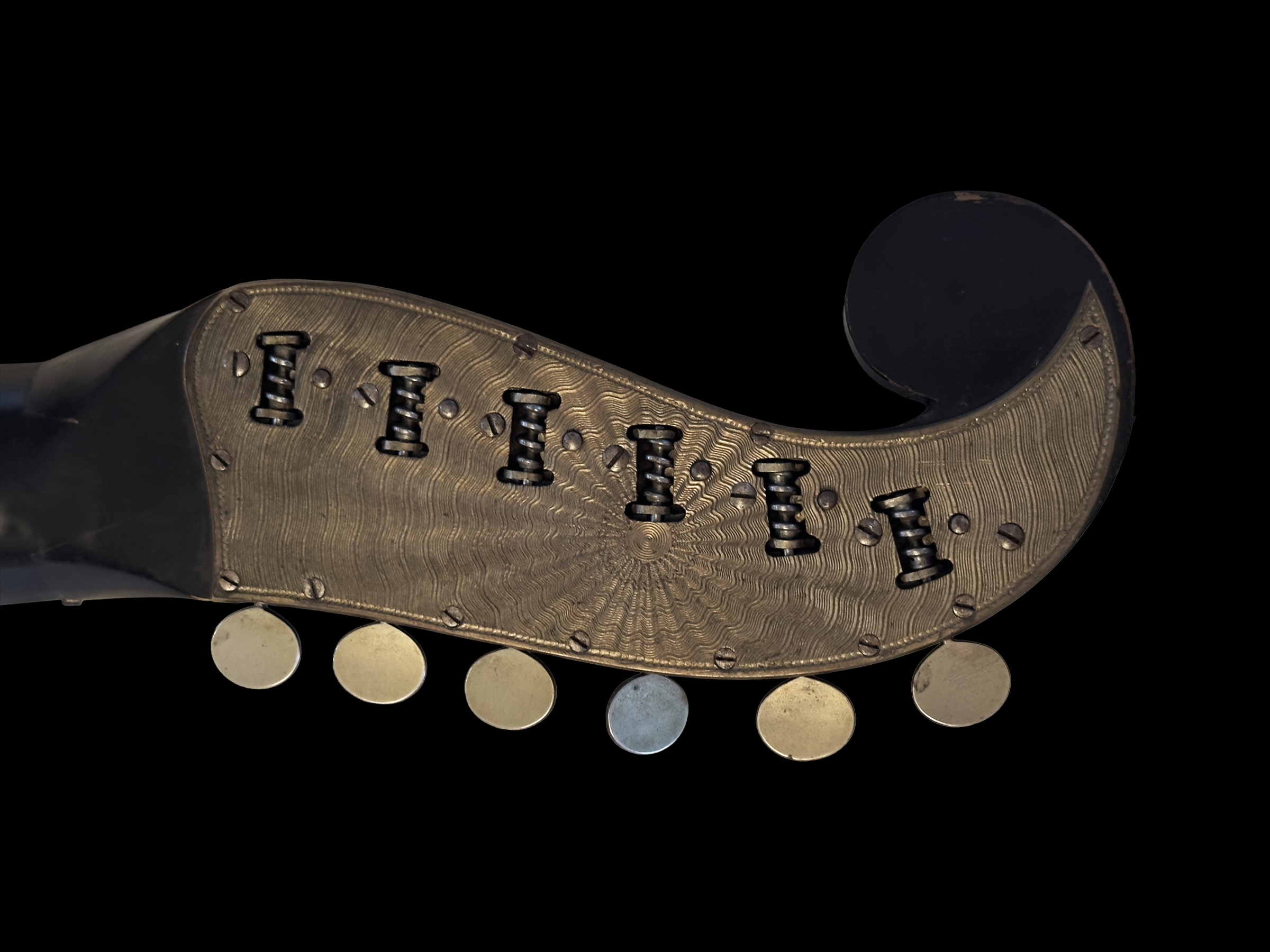
The “terz” guitar traces its roots back to the first decade of the nineteenth century. Born in Vienna, its name is derived from the Italian word terzo, or “third.” Its namesake aptly describes the instrument’s design: a smaller, brighter-sounding guitar built to be tuned a minor third higher than standard tuning. The shorter string length, typically in the 530–560 mm range compared to an average of 630–640 mm for a guitar, allowed for tuning to a higher pitch. Despite its tuning, the terz guitar was a non-transposing instrument for the player, sounding a minor third higher than the music written for it.
Specifications
Date
c. 1827
Location
Vienna, Austria
Length of Guitar
868 mm
String Length
558 mm
Upper Bout Width
228 mm
Waist Width
170 mm
Lower Bout Width
295 mm
Side Depth at Waist
74 mm
Soundboard: Spruce | Back: Flamed maple| Sides: Flamed maple | Details: Fitted with a scroll-shaped headstock with encased in-line tuners and adjustable neck mechanism
The terz rose to popularity during the first half of the nineteenth century coincident with the guitar craze that swept through the Continent and Britain. Even German émigré C. F. Martin introduced a terz model in America, debuting his Style 5 in 1854. Leading guitar virtuoso-composers of the era played and wrote for the instrument including Mauro Giuliani, Anton Diabelli, and Johann Kaspar Mertz. Appearing in ensemble music and in duets with the guitar, the instrument arguably reached its zenith in Giuliani’s Concerto in F-major, Op. 70 written for the terz.
Johann Georg Stauffer of Vienna (1778–1853) was the leading Austro-German guitar luthier in the first half of the nineteenth century. His innovative work and superior craftsmanship inspired a generation of guitar makers. Credited for introducing an adjustable neck mechanism, more durable metal frets, and encased inline tuning machines, his workshop in Vienna is also where Charles Friederich Martin trained before leaving for America in 1833 to start a guitar-making dynasty.
The Stauffer terz guitar in this collection is dated c. 1827. The label is stamped with Stauffer’s signature red-wax seal featuring the Habsburgian double-headed eagle. Printed on the label is Nach dem Modell des Luigi Legnani (based on the model of Luigi Legnani). The renowned Italian guitar virtuoso Luigi Legnani (1790-1877) collaborated with Stauffer on the development and design of his instruments.
The soundboard is made of spruce and the back and sides of flamed maple. It is a premium model featuring Stauffer’s patented adjustable neck mechanism operated by a key wrench that turns a bolt embedded in the heel. The scroll-shaped headstock features Stauffer’s encased inline precision tuning machines. The string length is 558 mm and the fingerboard is fitted with 22 metal frets.